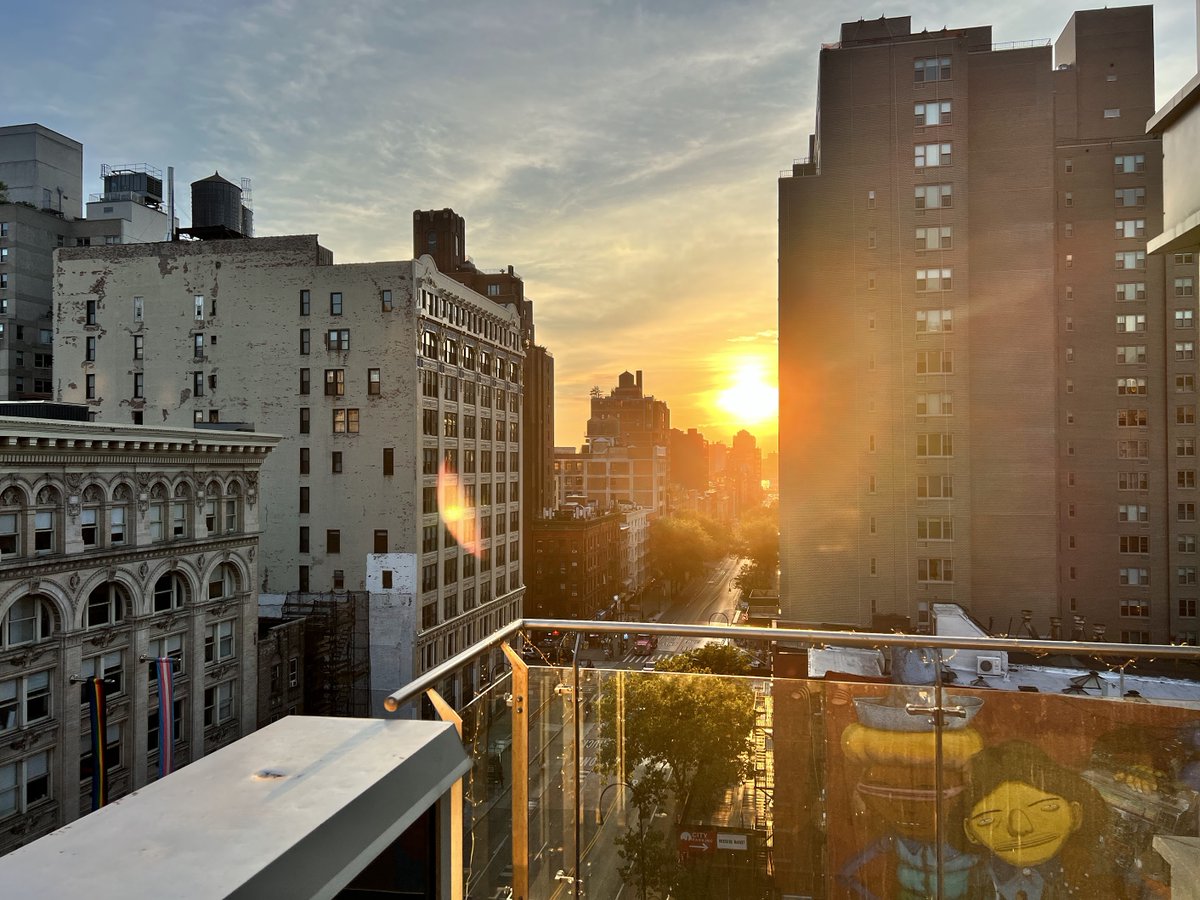
ok fine, SF wins
New York is, without a doubt, the greatest city in the world. It’s chaotic, vibrant, and exhilarating. I love the pace, the energy, the people I’ve met.
But after five amazing years, I’ve decided it’s time to move back to San Francisco.
If you had told me a few years ago I’d be excited about moving back to SF, I probably would’ve laughed. After spending three wonderful years at Berkeley, I moved to San Francisco in 2018. I didn’t love it — I left within a year.
For one, I was a fresh college dropout living in a pretty shitty (literally) part of SoMa, 6th and Howard. There was a homeless encampment right outside my door. That was no fun.
But also, the tech scene at the time felt spiritually stagnant, a graveyard of social apps and incrementalism. The tail end of the 2010s felt like the peak of the Great Stagnation. It wasn’t the Silicon Valley I’d grown up reading about and romanticizing. The energy, the idealism, the sense of frontier – none of it was there.
On top of that, there was this ambient negativity in the air. A lot of people seemed like they didn’t actually want to be in SF. They were just there because they had to be for work. That discontent was contagious.
So I packed up my bags and moved to NYC. I loved it. The energy was electrifying. People were happy. Even after COVID hit the city, it rebuilt itself with resilience and heart.
I practically became a spokesperson for NYC in the “post-COVID city wars.” I bullposted on the timeline. I convinced friends to move here. I talked endless shit about San Francisco: the gloom, the doom, the bad vibes. But in all that, I missed the fact that SF was changing. I was stuck in a pre-COVID view of the city, while it quietly started evolving.
Because when COVID hit SF, something interesting happened: all the people who didn’t really want to be there finally left. What remained was a community of people who actually liked the city. It was like a Great Filter. And what followed was an even deeper rebuilding phase than what we saw in New York. SF started to feel more optimistic and more alive.
(I recognize the irony, given I was one of the people who left… but in my defense, I left in 2019. Before COVID. Before it was cool. ti)
At the same time, the world itself changed. The Great Stagnation came to an end. Fueled by breakthroughs in AI, biotech, space exploration, VR, and more, the 2020s kicked off a new era of rapid technological progress. The frontier was open again.
And I want to move back to the frontier.
The tech industry is back in the Bay. During COVID, there was a real attempt to decentralize Silicon Valley into a diaspora of less dysfunctional cities: New York, Miami, Austin. But in hindsight, none of them really stuck. The Bay just has too much network effects. The talent density and culture was too sticky. It’s all coalesced back in SF.
Crypto might be the one exception. New York works for crypto in a way it doesn’t for most tech, largely because crypto still straddles the line between finance and tech. But that dual identity forces a choice: are you here to build financial products, or to push technical boundaries?
For me, the answer is clear, I want to be a technologist. And as I look toward the future of our products, like Polaris, the most important innovations won’t come from clever financial engineering. They’ll come from AI.
I believe we’re entering a phase where nearly every product becomes an AI product, even finance products. The breakthroughs that define the next decade will be about how deeply we can integrate intelligence into software. That means being where the AI ecosystem is being born. That means being in San Francisco.
But, this isn’t just about what we’re building today. It’s also about staying close to the forces we’ll need to understand tomorrow. We’re living through two overlapping revolutions: one geopolitical, and one technological. On one side, the unraveling of the Pax Americana global order; on the other, the intelligence explosion. Either of these would be transformative on their own. Together, they make the future feel increasingly unknowable.
Being in San Francisco can at least help with the latter. The AI industry is developing at breakneck speed, and from the outside, it’s nearly impossible to tell what’s real, what’s hype, and what’s bullshit. The only way to really understand what’s happening is to be immersed in it. To be close to the people building, theorizing, experimenting. To be inside the feedback loop, not reading about it from the outside. Being in SF won’t give all the answers, but it will at least give more signal, and right now, that matters.
Another big reason I’m going back west is that I’ve officially come to the conclusion that remote work is not viable, at least not for early-stage startups. You just can’t beat in-person collaboration. Ideas move faster in person. Context accumulates. Creativity compounds. Culture don’t get built in structured Zoom calls. It happens in hallway chats, lunch breaks sessions, and late-night tangents. You can’t schedule serendipity.
Osmosis started remote, out of path dependency, having launched during COVID. And while it’s not possible to completely change that in the short term, we can at least start consolidating more of the team there. My co-founder and several others on the team are open to move to SF.
I want to be present with our team and present within the broader industry. Be where the most important ideas are being debated, built, and tested.
New York might be the greatest city in the world. It’s definitely the most fun. But right now, I’m chasing something else: a front-row seat to the future.