Sparks
Highlights and quotes that sparked my curiosity, from books, articles, and other sources

by the mid-2020s, the Americans found that they would have to summon literal demons from the ether through the discovery of the sacred geometries if they wished to continue their grand civilizational project of maintaining 3% real gdp growth over the next decade
plausible is that we’ve only really had one exceptionally innovative culture in all of human history, so innovative that by 1870 all the nation states in the world had gotten the memo “the British are winning, copy whatever the British are doing NOW or die”, which is why we all wear suits, play soccer and golf, have grass lawns, enjoy tea and mountaineering, and are emotionally repressed…

“That he does the best introductions of anyone I know. A testament to the care he puts into getting to know people is the skill (and humor) he has in describing them to one another.”

I also don't think Nick land is actually a nihilist(?) from what I understand he just thinks the cybernetic system is a more beautiful and rational idea than humanity and we shud serve that rather than ourselves.

Women lose their virginity and innocence through sex and men lose their virginity and innocencewith violence.

We outsourced our morality to two amoral mechanisms: the free market (do people want it?) and the law (is it legal?).

This is probably the single feature that makes China the most unique as a civilization in human history: it is pretty much the only one where religion never had a say in political affairs.

around 1046 BC, the Zhou overthrew the Shang and immediately faced a big problem of legitimacy. The Shang had claimed to rule because Heaven had chosen them. If that were true, then the Zhou had just committed the ultimate act of sacrilege. How do you justify going against God’s will? The answer the Duke of Zhou (who can thus be credited as the - perhaps unwitting - inventor of secularism) came up with was essentially to say that Heaven's mandate is not a birthright but a contract - conditional on the virtue of the ruler and good governance. It might not sound like much but this idea completely changed the whole equation: suddenly the legitimacy of power didn’t rest on God’s will but on man’s moral judgement, on whether the ruler had virtue (德, Dé) and governed well. Which meant that, ultimately, the people - as opposed to a God - became the arbiter of whether a ruler is legitimate.

• Against expectations, China did not liberalize as it became wealthy. The US populous must now reconcile with a near-peer rival which rejected its ideology, and yet has achieved astonishing results, lighting a clear alternative path for developing nations. The liberal democratic monopoly on economic and technological supremacy has been cast in shadow.
AI is the ultimate form of technological leverage, converting capital directly into commoditized intelligence. This inherently increases the share of capital at the expense of labor. There is clearly a tension between near-infinite returns to capital and a democratic society whose economic model is built largely around labor-intensive services. We should not gas light people that this is not the case.
Then most people get punched in the mouth.
The funding pulls out. The cofounder walks. The market wasn't ready. Things change. You fall in love. You get married. You have a kid. You slowly realize that not everything in life revolves around the singular pursuit of your dreams. And maybe your initial dreams were more memetic than anything - that you wanted to change the world more to be known than because you had found your true purpose. You are still ambitious, but you are hemmed in by realities now. You have dreams but you also have dependencies. Little, actual, flesh-and-blood human beings that need to be fed and bathed and housed
We see major enterprise software contracts priced in "outcomes delivered" rather than "per seat."
By late 2026, a major tech giant (Apple or Meta) acquires a neuro-modulation patent portfolio, signaling that wearables are now for "writing" to the brain, not just "reading" it.

I had an amazing life. I gave it everything I had. If you got any benefits from my work, I'm asking you to pay it forward as best you can. That is the legacy I want.
Be useful.
And please know I loved you all to the end.

They are literally 1:1 copies of Roblox games, plus gorilla tag locomotion.
If Roblox had died in 2010 (like it would have if they didn’t have superhuman perseverance), no one on earth would suggest that the VR-native way of traversing locations would be to have them on a flat discovery feed where you teleport from room to room.

Life is littered with irritants that you don’t notice until they go away. The noise of your city environment, until you spend a night in the country. Blurred vision, until you try on glasses for the first time. My husband talks about meditation, and in the extreme, awakening, this way — as finally noticing something that has always been true but that you were prevented from seeing by some tragic error in perception.
Less obvious is the fact that the absence of something can be like this, too, can exert a constant toll on you without you realizing it’s happening. Have you seen those videos of kids trying on colorblindness-correcting glasses, or hearing their mothers’ voices for the first time after getting cochlear implants? There are hungers you don’t feel until they are sated.
I believe that thinkers from St. Augustine to Blaise Pascal to C.S. Lewis have had something like this in mind when they’ve spoken about the “god-shaped hole” at the center of existence.

Slack is exception handling. When there’s no other way to make sure someone sees and update, or knows context, Slack is the 911 that can be used.
Slack serves three functions:
• Else statement. Slack is the exception handler, when specific productivity apps don’t have a way to handle something. This should decrease in usefulness, as the apps build in handling of these use cases, and the companies build up internal processes.
• Watercooler. Slack is a social hub for co-workers. This is very important, and full of gifs.
• Meta-coordination. Slack is the best place for meta-levels of strategy and coordination that don’t have specific productivity apps. This is really a type of ‘else statement’, but one that could persist for a while in unstructured format.

Study the science of art. Study the art of science. Develop your senses—especially learn how to see. Realize that everything connects to everything else. — Leonardo da Vinci

This is what a16z has built: The ability to make certain futures feel inevitable by controlling the infrastructure through which we understand what's possible.

In the Scottish highlands, one cafe in Invermoriston (population 264) had no business being as good as it was. As of this writing, with 1,007 Google reviews, it has a rating of 4.9. Glen Rowan Cafe wins my establishment of the year. They sell six cakes, all homemade. Of all the ventures I’ve beheld, none stand so defiantly against the impersonal forces of optimization as this improbable gem.
I feel lucky to have visited Beijing almost twenty times in my life, seeing exactly what a tenfold increase in GDP per capita looks like.

What is respected is continuing to participate in building the future even after your career has reached maturity — it is a flex to say, for example, that you sponsored someone’s research if it turns out to be important.

Libertarians are defined by their belief in maximizing or almost maximizing the personal freedoms of individuals—whether because they hold it as a moral principle, or because they believe it’ll result in utopia, or because it’s what the founding fathers would’ve wanted, or some other justification.

savvy users can manipulate the chatbot into calling tools. So you can never give a support chatbot real support powers like “refund this customer”, because the moment you do, thousands of people will immediately find the right way to jailbreak your chatbot into giving them money. You can only give your chatbots tools that the user could do themselves - in which case, your chatbot is competing with the usability of your actual product, and will likely lose.

For the Roman aristocracy, who lost little which they valued and gained much in terms of freedom from the central imperial authority, there may have been not much reason to notice they were now part of a barbarian kingdom.

But when we’d tell other pros what we were doing, the response from most was “nuh-uh, that’s not a thing.” They weren’t willing to consider the possibility that reads were valuable, maybe because they didn’t want to feel obligated to study them.
Apply for some jobs you really don’t think you’ll get so you can learn to decouple “no” from surprise and dejection.
Apply for some jobs you really don’t think you’ll get so you can learn to decouple “no” from surprise and dejection.
Mark Zuckerberg Has Always Been Good at Communicating Big Moments:...
by Caryn Marooney

Big Moment Communications Framework: S.W.I.M.
It’s key is that it’s both broad and specific, it is for both internal and external audiences and it is both aspirational and prescriptive.
- S: Strategy — Broad Strategy or Pivot
- W: Why — Why Now, Why You
- I: In Action — Specific, Measurable Actions
- M: Mistakes — Mistakes will Happen

i still believe in consciousness ofc.
it has utility as a description of physical processes, just as temperature helpfully explains the motion of gaseous atoms and ‘iPhone’ describes a bundle of clever engineering

China seeks to commoditize their complements. So, over the following months, I expect a complete blitz of Chinese open-source AI models for everything from computer vision to robotics to image generation.
China’s core competency is exporting physical widgets, more than it is software.
Villains change the status quo. Heroes protect it.
Villains see the world not as it is but as it could be. They rail against what is. They lever their will against the world to change it.
Heroes protect what is. They see the beauty in the world, and they know the limits of an individual will. They seek to preserve the good and limit the possible bad.

MAGA craves an elite, but is continually disappointed that the actually existing elite doesn’t comport according to its preferences
Trumpism’s biggest failure in terms of its long term prospects is its inability to consolidate a new leadership cohort. At best you have some opportunistic types who will move on to the next thing the moment power shifts

The New York Times’ explicit model is to provide a narrative that increases the number of paying subscribers. This is also true about non-subscription media too, due to follower accounts and engagement on internet channels. Whether or not there’s a story, they have to provide one.
You don't really hear "dumb blonde" jokes anymore.
I have to assume these were a relic from the era of mass Polish and Scandinavia immigration.

A complement is a product that you usually buy together with another product. Gas and cars are complements. Computer hardware is a classic complement of computer operating systems. And babysitters are a complement of dinner at fine restaurants. In a small town, when the local five star restaurant has a two-for-one Valentine’s day special, the local babysitters double their rates. (Actually, the nine-year-olds get roped into early service.)
All else being equal, demand for a product increases when the prices of its complements decrease.
…In general, a company’s strategic interest is going to be to get the price of their complements as low as possible. The lowest theoretically sustainable price would be the “commodity price”—the price that arises when you have a bunch of competitors offering indistinguishable goods. So:
Smart companies try to commoditize their products’ complements.
If you can do this, demand for your product will increase and you will be able to charge more and make more.
The Really Saad Truth Though That Is to Get To...
by Antonio García Martínez (agm.eth)

The really Saad truth though that is to get to the 90/100 satisfaction requires being supremely unhappy at even 80/100, thereby producing the necessary drive, and so on up the scale in a Xeno’s paradox of unhappy achievement.
We’ve also discovered an amazing hack: you can just teach a toddler to say whatever you want. We taught her to say “mamma mia” whenever she falls over, which I highly recommend to other toddler parents.

It doesn't necessarily matter whether the ideas on which this canon is built are in their own right functional, what matters is that the canon is sufficiently off-putting and impossible to parse for the masses, which in turn makes it alluring to the ambitious strivers with refined taste who have it as a top priority to keep distance from the plebeians
any successful ideological project also needs a "tip of the iceberg" that "the people" like: slogans, pamphlets, memes, simpler media, etc
How did the communists maintain dominance for so long? In many ways, exactly through this bifurcated distribution -- they had the pamphlets AND the "monastery", precisely because they maintained alluring esoteric canons "nobody" read

The biggest systematic risk of learning a language isn’t having an inefficient process but rather quitting. Too much emphasis is placed on process and not perseverance.

Jevons' Paradox: when technological advancements increase the efficiency of resource use and reduce cost, it leads to greater total consumption of that resource. When more is created affordably, more is consumed. Sometimes disproportionately so.
When two or more products complement each other, changes in the availability or cost of one invariably influences the pricing of the other(s). Profusion on one side amplifies insufficiencies on the other. Equilibrium accounting.
Standing in Jobs’s garage, Markkula knew that Wozniak’s Apple II computer was a magnificent answer to the hopes of anyone who had ever longed to own a machine. What he did not know, however, was whether a company could be built around that machine. He gave Jobs and Wozniak the same advice that he had shared with other aspiring entrepreneurs: write a business plan. Figure out your supply costs, the size of the market, the distribution paths. He thinks he even suggested that since it was impossible to estimate the potential size of a nonexistent market (for personal computers), the number of telephones in US households might provide a good starting point.

• What people say is overoptimism is just optimism.
• What people say is overcommunicating is just communicating.
• What people say is overdelivering is just delivering.
• What people say is micromanagement is just management.
• What people say is ruthless prioritization is just prioritization.
Actually living this way will seem crazy, and that’s ok. There is no Apple without Jobs’s “obsessive” attention to detail. There is no SpaceX or Tesla without Elon’s “maniacal” drive for execution. I have never seen ordinary effort lead to extraordinary results.

The first step is to find someone on the team and ask for 30 minutes with them. In that meeting you have a simple agenda:
• For the first 25 minutes: ask them to tell you everything they think you should know. Take copious notes. Only stop them to ask about things you don’t understand. Always stop them to ask about things you don’t understand.
• For the next 3 minutes: ask about the biggest challenges the team has right now.
• In the final 2 minutes: ask who else you should talk to. Write down every name they give you.
Repeat the above process for every name you're given. Don’t stop until there are no new names.
It’s easy to conflate ideas not guaranteeing success with them not mattering
A common thought-chain you might have when thinking about the importance of ideas for success is:
- Person X had a good idea
- They failed
- Therefore ideas do not guarantee success
- Therefore ideas are not important for success
Steps 1 through 3 are valid. The jump from point 3 to 4 is not.
When we first went to write this section, Stephen started to write about how obvious Clubhouse was in retrospect. But then when pressed by Alexey, Stephen realized that while live audio on an app might be obvious, the other aspects of Clubhouse’s implementation—rooms, microphone privileges, hand-raising combined with elevation to the stage, innovative privacy violations—are not obvious at all and he could not have come up with them himself.
In the same way most people think they understand how bikes work but cannot come close to drawing a working bike, many of us think we could have generated a seemingly obvious idea when really we would have come up with a version lacking key components that make the actual idea work.
‘ideas don’t matter’ is an attempt by VCs to ‘commoditize their complement’
I often look at people's achievements and think: I wish I'd done that. More rarely, I see the work that went into those achievements and think: I wish I were doing that. Chase the latter.
Betting on Unknown Unknowns - by Alexandr Wang Betting on Unknown Unknowns
by Alexandr Wang


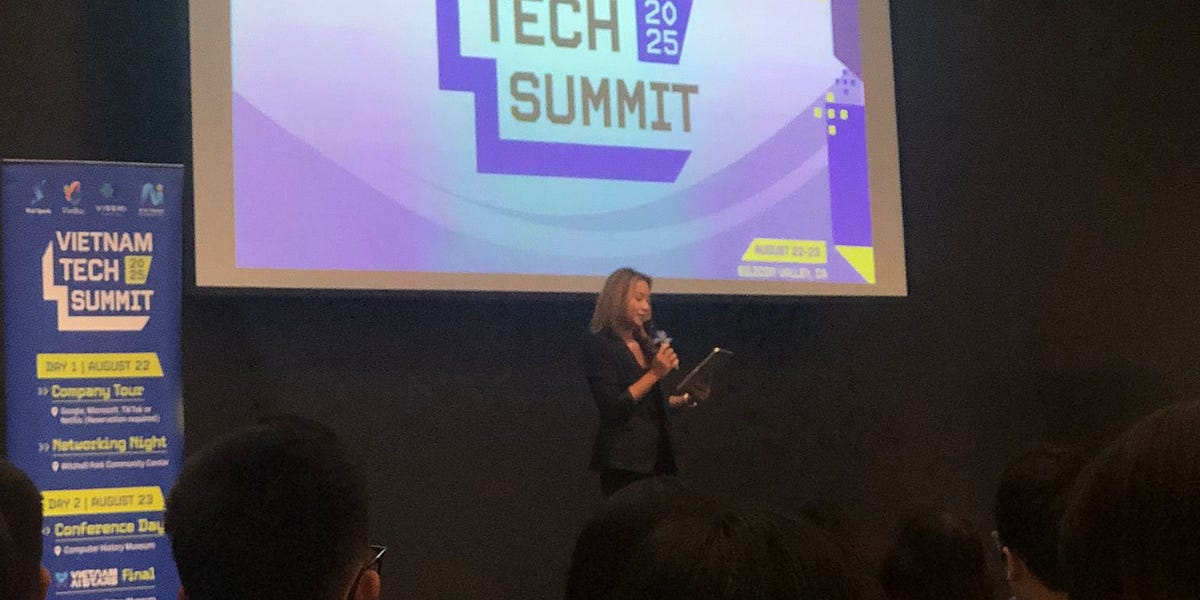
Reminds me of my favorite line from Brian Chesky about Founder Mode and Hiring: whenever he hires someone, he tells the candidate before introducing them to the team that…
“My job is seeing potential in you that you are not even see it in yourself. I will tell you something is not good enough. All the time. When I am saying that I am not saying you are not good enough. When I saying that what I mean is I see potential in you that you don’t see in yourself.”
Punch your reader in the face. If they’re not feeling it, they’re not going to keep reading.
I feel like most computation in the brain is chemical, not electrical. Electricity produces too much heat. I think the implications of this are underappreciated. e.g.
This is especially funny to me because when I became convinced that AGI is coming very soon in 2022 I remembered how persuasive this video was for me in 2020 and I kept thinking about watching it again and checking out its arguments given my new beliefs but somehow felt anxious that I might be wrong again and ended up not going back to this video and rewatching it until late 2023 when I’d already stopped being worried about AGI again. Something very deep in this.

An investor says “I’m excited about this idea.” She puts cash on the table. She watches for gains and losses. Thrilling.
An entrepreneur (artist) says “I’m excited about this work.” She shows up to the table and grinds—for hours…days…years. She eventually compresses the nitty gritty pieces into a passion snowball. Exhausting.
A dreamer says “I’m excited about this outcome.” He contemplates the ideal table, whispers an incantation, wills potential into motion. He sees change even when nothing happens. Easy.
You can be one or more.
But there are no other categories.

for decisions: autoresolve (1) on specific date (2) to the scary one
let people tell you no. don’t make the decision for them.
(my definition of “defeating death” means “getting to constant probability of death every year of life”. This still implies finite expected lifespan rather than immortality)
Every Productivity Thought I've Ever Had, as Concisely as Possible - Alexey Guzey
by guzey.com

Here’s what you should do if you’ve been procrastinating for an entire day:
- Accept that you won’t do anything today and try not to get angry at yourself
- Set the alarm for the time you will be preparing to go to bed today
- No, really. Do it. It will take 20 seconds
- Procrastinate for the rest of the day
- When the alarm rings, put your laptop and everything you need for work in your backpack
- When you wake up, try to not check social media, email or anything else. Do not take anything out of your backpack
- Get dressed, take your stuff, and go to a library, cafe, whatever else where you either
• never been to
• have been to but never procrastinated within the last 6 months - While getting to that place, figure out what you want to be doing today
- Do it
- Return home in the evening. Don’t take anything (especially your laptop) out of your backpack. Repeat steps 6-10

During the scientific renaissance, thinkers and tinkerers could jump from one field to the other, without much friction. From this freedom, new worldviews were forged and one of the most enduring came from Francis Bacon, who visualised the scientific project as an expedition into uncharted waters.
Interdisciplinarity sat at the heart of scientific progress and adoption. Young, talented apprentices were able to follow their hunches from blacksmith shops to alchemy labs. Their curiosities did not need to be constrained by niche disciplines but they could forge their own paths, and become true polymaths.

local top is always when the zany smart guys you know just start quitting their jobs with nothing lined up.
I’m also feeling the call of the wild “what if I quit for a few months before doing something new?”
This isn’t necessarily bad! Just don’t expect the market to stay hot for when you want to return.
NFA but if you do this counting on all time high stock portfolios, ask yourself if you’d panicked if it dropped 30%. If so, consider more liquidity.

China is more than willing to spot us $10-$100 trillion in order to let us completely destroy our societies with debt, entitlement spending, overregulation, de-development, and mass immigration. More predictable victory that way than fighting WW3!
Actually we can because the Chinese have no plans to invade North America or Europe and depose the current ruling elites. Therefore China is not a military threat to our ruling elites. In fact, our ruling elites face no military threat at all.
x.com/GreenPlusAnE/s…
The thing that is supposed to stop total comical self-destruction is the threat of military subjugation by an outside power. The problem is that due to overwhelming U.S. power and the nuclear taboo, there is no actual existent threatening military power to the Western world.
Boomers were the first generation to reproduce at below replacement rate while maintaining economic institutions requiring growing populations, like social security. They have as a result also been the largest voting bloc for decades.

our third president, thomas jefferson, was immensely autistic
he spent much of his time inventing questionably useful devices, getting hung up on and beefing over irrelevant abstractions, pursuing unwise relationships w subordinates, and recording data for no particular reason
Been Reading About Burnout and Its Really Helped Me Understand...
by José Maria Macedo

cause of this cynicism is frustrated idealism. People start off very idealistic about their job and pour themselves into it. Over time, those ideals clash with reality. To succeed, they must increasingly put aside or even go against their ideals. Repeated violations of values leads to anger, shame and betrayal, especially when they feel trapped by incentives
In order to avoid confronting these feelings, ppl protectively detach, using sarcasm/cynicism as armour. Basically what George Carlin said: “Scratch any cynic and you will find a disappointed idealist”
Math and philosophy are too fun. Take math up to real analysis and algebra. Be careful around superstimuli that remove you from the real world.

Soon Islam is going to find that Europeans have not forgotten how to European. I wouldn't fuck with them too much.
Sincerely, a Jew.

The unwritten rules are the real rules and the written rules are guidelines and this is why life is hard for autistic people
And then autistic people always get in trouble when the break the written rules because they don't break them right according to the unwritten rules :(
The key point is that immigration fractures national markets. Once a niche is taken over, outsiders can no longer compete in that niche.
There is still competition within ethnic groups inside the niches, but these groups are tiny fractions of the population and often have informal institutions and kinship structures that allow them to act as cartels.
Cambodians run about 80% of the donut shops in Southern California (despite being only 0.17% of the state’s population). The Cambodian donut empire got its start with refugee Ted Ngoy, who first learned the trade thanks to an affirmative action program to increase minority hiring at Winchell’s Donuts. The Cambodians were able to completely dominate this traditional American culinary sector through a mix of extended family credit and the use of tong tines, an informal lending club.
This ability to borrow money cheaply made financing much easier for them than for their American competitors. Once the business was purchased, Cambodians could also keep operating costs down through informal employment of family labor, allowing them to get around expensive income taxes, not to mention labor laws and regulations — including ones around child labor.
One can encounter Hispanics and Indians in rural Arkansas. They’re too dispersed to form something along the lines of a Spanish or Hindi Quebec. They’re also too inclined to assimilate to America’s modern consumer identity.

Or, influenced by milder environs, would its members have chosen simpler, less stressful alternatives – preferring to angel invest, dabble in side projects, and relax in the paradises of Tuscany or Cap d’Antibes.
For too long, the continent’s most productive founders have chosen the latter path.
It's surprisingly hard to pin Paul Graham down on the nature of the special bond he thinks hobbyist programmers and painters share. In his essays he tends to flit from metaphor to metaphor like a butterfly, never pausing long enough to for a suspicious reader to catch up with his chloroform jar. The closest he comes to a clear thesis statement is at the beginning "Hackers and Painters":
"[O]f all the different types of people I've known, hackers and painters are among the most alike. What hackers and painters have in common is that they're both makers."
To which I'd add, what hackers and painters don't have in common is everything else.
The reason Graham's essay isn't entitled "Hackers and Pastry Chefs" is not because there is something that unites painters and programmers into a secret brotherhood, but because Paul Graham likes to cultivate the arty aura that comes from working in the visual arts.

I do think a lot of the stuff that generated so much sound and fury last time was kind of based on an assumption that 2020 was the worst society could get and that flawed liberal democracy was the floor. A kind activist version of ZIRP. I don’t think anyone will be under that illusion in a few years.
Most AI research has been conducted as if the computation available to the agent were constant (in which case leveraging human knowledge would be one of the only ways to improve performance) but, over a slightly longer time than a typical research project, massively more computation inevitably becomes available. Seeking an improvement that makes a difference in the shorter term, researchers seek to leverage their human knowledge of the domain, but the only thing that matters in the long run is the leveraging of computation.
The bitter lesson is based on the historical observations that 1) AI researchers have often tried to build knowledge into their agents, 2) this always helps in the short term, and is personally satisfying to the researcher, but 3) in the long run it plateaus and even inhibits further progress, and 4) breakthrough progress eventually arrives by an opposing approach based on scaling computation by search and learning.
One thing that should be learned from the bitter lesson is the great power of general purpose methods, of methods that continue to scale with increased computation even as the available computation becomes very great. The two methods that seem to scale arbitrarily in this way are search and learning.

Hanlon’s razor says never to attribute to malice that which is adequately explained by stupidity. The straight read is that this is a factual claim: malice is salient but stupidity is common, so a bias towards the latter leads to a more accurate worldview. But it can be also read as a matter of taste, of spiritual stance. Wouldn’t you rather live in a world of misguided fools who merely need correction, as opposed to a world of irreconcilable conflict?

DeepMind is going
for the Science Victory
Meta for the
Domination Victory
Anthropic for the
Diplomatic Victory
OpenAI for the
Religious Victory
DeepSeek for the
Score Victory
xAI should go for
The Cultural victory
By the middle of the 19th century, however, advances in technology were reducing the need for any kind of scurvy preventative. Steam power had shortened travel times considerably from the age of sail, so that it was rare for sailors other than whalers to be months at sea without fresh food. Citrus juice was a legal requirement on all British vessels by 1867, but in practical terms it was becoming superfluous.
So when the Admiralty began to replace lemon juice with an ineffective substitute in 1860, it took a long time for anyone to notice.
By the 1870s, therefore, most British ships were sailing without protection against scurvy. Only speed and improved nutrition on land were preventing sailors from getting sick.
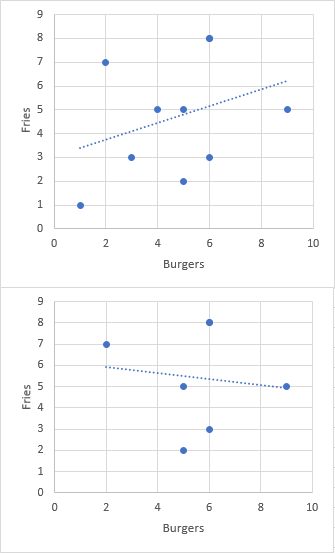

An example of Berkson's paradox:
• Top: a graph where talent and attractiveness are uncorrelated in the population.
• Bottom: The same graph truncated to only include celebrities (where a person must be both talented and attractive, in some combination, to have become a celebrity). Someone sampling this population may wrongly infer that talent is negatively correlated with attractiveness.
With any order from the master menu comes the Bread Basket, which should be treated as you would treat a basket of wax fruit, that is, as a purely decorative ornament. It is considered bad form to actually eat anything from Bread Basket, as this will force the restaurant staff to send someone down into the bread cellar for a replacement roll before placing it on the next table.

The simplest idea I present is that China is an engineering state, which brings a sledgehammer to problems both physical and social, in contrast with America’s lawyerly society, which brings a gavel to block almost everything, good and bad.

Those who value civilization are called conservatives. For them the enemy is barbarism.
Those who value equality are called liberals. For them the enemy is exploitation, that is, the abuse of the free market by the rich or by the many to oppress the poor or the few.
Those who value liberty are called libertarians. For them the enemy is slavery, that is, the abuse of the authority of the sovereign to oppress the citizen.

I looked at my good wife who was bursting with vigor and passion, whose eyes followed my lips as I mouthed our ten-thousand possible futures, all of them sputtering and bellowing from me like so many wild-eyed incantations and spells. “I would do that,” she would always dutifully say, whatever it was.
It was only a few weeks ago that she admitted she was simply giving me space to think. God bless her.

The Netflix unlimited PTO thing works because they also give their employees insane goals and fire them if they don’t meet the goals

Beauty is obvious. Ugliness comes with a lecture.

basically the function of your professional life is to find the most natural capital structure that allows you to turn the things you do as naturally as breathing and walking into compounding capital over decades
that best structure is very rarely a venture backed c corp
if you read the history of guys that have truly lived up to their best and highest callings, and did so in a way that created durable enterprise value
very few of them were on top of recognizable structures

left-wing libertarians are just freedom communists: they want to redistribute your freedoms freedom doesn't exist in nature, it is created by men, and if you gift it to those who won't help you maintain the freedom bubble, then you'll lose it
I Worked at an Office Like This for Almost 2...
by terminally onλine εngineer 🇺🇦🇪🇺🇺🇸 ~ new era

i worked at an office like this for almost 2 years and i can confirm that just like with any other things in society you have 10% of the people doing insane things generating revenue while other 90% do nothing, however u need this type of environment to attract the top 10%
Google and Windsurf, Stinky Deals, Chesterton’s Fence and the Silicon Valley Ecosystem – Stratechery by Ben Thompson
by stratechery.com
The second group that benefits from large tech company acquisitions is investors. If one of their startups creates something useful, that investment can earn a return even if said startup does not have a clear business model or user acquisition strategy. To put it another way, investors have the freedom to be more speculative in their investments, and pay more attention to technological breakthroughs and less to monetization, because there is always the possibility of exiting via acquisition. This benefit accrues broadly: more money going to more initiatives is ultimately good for society.
America in the late 20th century is not divided by class. It is divided by channel. A hobbit is an ABC-NBC-CBS American. An elf is an NPR-PBS American. Left and right are literally the spectrum on your radio dial.
At its closest point, Japan is 120 miles from the Eurasian landmass, which is among the reasons why it has never been successfully invaded. The Chinese are some five hundred miles away across the East China Sea; and although there is Russian territory much closer, the Russian forces are usually far away
In naive economics, individuals and firms act on behalf of their own interests, but government does not. Instead, government corrects market failures and redistributes income from a God’s-eye perspective.
But what if government actions are instead result from officials acting on behalf of their own interests? Posing that question gave rise to what become known as Public Choice Theory. I prefer to call it Political Realism.

$ have value because the gov taxes 30%+ of all incomes in $, even those earned in eth or sol or euros or yuan. As long as US is home to globally competitive products, even id the gov prints $, those products will sell for yuan or btc or euros, and those companies will convert those to $ to cover taxes. The key part here isn’t the taxes, it’s the globally competitive products. Without those no amount of financial engineering will matter.
The most basic source of market failure is having a fixed salary. Fryer cannot simply tell his employer, “I would like to be paid for another hour’s work as an economics professor.” If he could, then in one hour he could earn enough to pay for many hours of lawn care, and he might think differently about mowing his own lawn.
Another source of market failure is taxes. If I do my own laundry, I incur no tax cost. But if I outsource to a business, then sales taxes, payroll taxes, and income taxes all get triggered by this activity. Similarly, there is a “tax wedge” that raises the cost of eating in a restaurant relative to home cooking.

You have to let your life go fallow sometimes, like a crop rotation giving the land time to bring forth new fertility. This is actually a consequence of a fairly general theorem about how to find treasure in complex search spaces: The best search strategies for complex problems like life generally don’t seek out particular homogeneous objectives, but interesting novelty.

Say what you will about @jack but it's undeniable that he's a true builder and creative at heart ,truly motivated by building and surfacing things that empower and expand the human experience.


In addition to importing political values, the United States also started importing their comics and cartoons, which deeply influenced the style of manga at this pivotal period. Osamu is known as the Japanese equivalent to Walt Disney, who he considered a major inspiration during this time.
The best pitches I hear explicitly focus on the unexpected. They tell me something that I can't already tell. Here's a bad example:
Worldwide banking is a massive market.
This sentence gives me zero information. It's something I already knew.
Highlighting surprise comes from emphasizing information that I likely don't know. Here's a great example:
With our group therapy product, we see an 80% repeat visit rate. That's in comparison to a 15% repeat rate of a standard therapist.
Hearing this immediately gets my attention. I didn't realize the standard therapist rate was so low. This startup must really be onto something!
But here's my advice: think of yourself as a founder first, and CTO second. Stay humble and don't let the title of CTO get in the way of what's best for the company.
The first thing to know about OpenAI is how quickly it's grown. When I joined, the company was a little over 1,000 people. One year later, it is over 3,000 and I was in the top 30% by tenure.
An unusual part of OpenAI is that everything, and I mean everything, runs on Slack. There is no email. I maybe received ~10 emails in my entire time there. If you aren't organized, you will find this incredibly distracting. If you curate your channels and notifications, you can make it pretty workable.
OpenAI changes direction on a dime. This was a thing we valued a lot at Segment–it's much better to do the right thing as you get new information, vs decide to stay the course just because you had a plan.
Nearly everything is a rounding error compared to GPU cost. To give you a sense: a niche feature that was built as part of the Codex product had the same GPU cost footprint as our entire Segment infrastructure (not the same scale as ChatGPT but saw a decent portion of internet traffic).
OpenAI uses a giant monorepo which is ~mostly Python (though there is a growing set of Rust services and a handful of Golang services sprinkled in for things like network proxies). This creates a lot of strange-looking code because there are so many ways you can write Python. You will encounter both libraries designed for scale from 10y Google veterans as well as throwaway Jupyter notebooks from newly-minted PhDs. Pretty much everything operates around FastAPI to create APIs and Pydantic for validation. But there aren't style guides enforced writ-large.
When it comes to personnel (at least in eng), there's a very significant Meta → OpenAI pipeline.
Since ChatGPT took off, a lot of the codebase is structured around the idea of chat messages and conversations. These primitives are so baked at this point, you should probably ignore them at your own peril.
If you're a founder and feeling like your startup really isn't going anywhere, you should either 1) deeply re-assess how you can take more shots on goal or 2) go join one of the big labs. Right now is an incredible time to build. But it's also an incredible time to peer into where the future is headed.
Or, you can delegate outputs to downscale intelligences (including humans lol). What is the maximum necessary API surface for most job-like tasks? You probably don’t need a GPU to describe it. We already have a protocol for connecting APIs…
You end up with an ecology of intelligences. Canopy models, undergrowth models. Shrubbery models. But canopy species always want to close the light off for competition. Which corporate biome will you inhabit?
I think it was maybe 2004 that Instant Bloomberg was introduced and began to write the book on product stickiness.
Soon, you were either on Bloomberg or you “didn’t exist”. It was an obnoxious, yet incredibly common networking practice to meet someone and instead of exchanging business cards, you’d promise to just ‘find them on Bloomberg’. If you weren’t a subscriber it instantly impacted your credibility with potential clients. It became an effective rite of passage for a young trader to “get their Bloomberg”.

The non-bank sector of the economy is the sum of government and the non-bank private sector. With the government always running a balanced budget, and having no debt, the government’s financial equity is zero. Therefore, the financial net worth of the non-bank private sector is negative, and precisely equal in magnitude to the positive equity of the banking sector.
Here we can turn to history: when its financial net worth was negative, or heading in that direction, the private non-bank sector borrowed money from the banks to speculate on the value of nonfinancial assets.
Nonfinancial assets are things like shares and houses. Even if people buy shares with margin loans, and houses with mortgages, the shares and the houses themselves are assets to their owners, and liabilities to no-one.
When we put a monetary value on those assets, based on the price they would realise if we sold them into the current market, then we get a necessarily positive sum. Add this positive sum to your negative financial equity, and you come out with a positive figure. This lets the private non-bank sector sleep easy at night, comfortable in the knowledge that its overall net worth is positive.

When you do that, you’ll see the formula for successful slogans pretty quickly. "Think Different," "Make America Great Again," "Just Do It,” “Got Milk?” all follow the same structure: few words, simple message, easy to remember and repeat.

“What’s one piece of knowledge you’d want any civilization to preserve no matter how they rank on the Kardashev scale?”
: I think something like the possibility of new knowledge being discovered. It might sound trivial but there are many many societies in human history that have had a very strong preconception that everything that we know today has always been known and anything that is introduced in new must be an error.
a good heuristic for whether you believe something emotionally vs. intellectually is how you react to someone disagreeing



an interesting friend group should be like a cinematic universe.
Cinematic universes have a shared oral history, where the constituents (and audience) generally agree on some sort of origin story. The moment that brought you all together, the delicate plot points that changed the course of your mutual story, the stories that get told with incrementally more exaggeration every year until they’re hardly recognizable from the truth. But you don’t care: you’re enjoying the warmth of your shared history.

In the 1952 Texas gubernatorial election, incumbent Allan Shivers ran on both the Democratic and Republican tickets, beating himself 73%-25%.
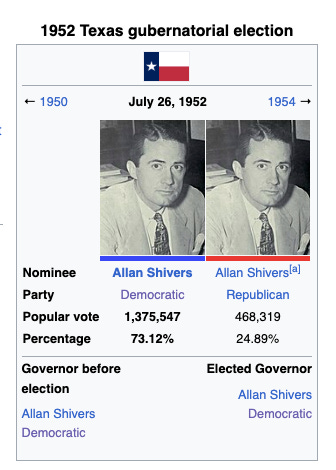
Although Shivers was a Democrat, the Republicans nominated him too as part of a galaxy-brained plan to encourage Shivers supporters to vote straight Republican (h/t BobaCalifornian).
IF GOD IS DEAD THEN BY GOD WE WILL BUILD A NEW ONE

whenever i see a majority americans want anything, i remember a majority are also retarded

"Without the freedom to transact, you have no other constitutional rights"
And mostly they look at me strangely and I look at them strangely because it seems obvious to me
Freedom of speech might require such activities like:
✅A website
✅A pamphlet
✅An advertisement
✅Paying a graphic designer
✅Travelling to a different location
All of which "cost money"
Freedom of assembly might require such activities like:
✅Taking a train to Washington DC
✅Booking a hotel room
✅Hiring a taxi
✅Buying a hot dog with mustard while you assemble
All of which "cost money"
Freedom of religion might require such activities like:
✅Renting a space for a facility
✅Paying the salaries of religious officials
✅Buying food and consumables
All of which "cost money"
I can go on, but I think the point is clear. The exercise of rights costs money.

To understand context engineering, we must first expand our definition of "context." It isn't just the single prompt you send to an LLM. Think of it as everything the model sees before it generates a response.

• Instructions / System Prompt: An initial set of instructions that define the behavior of the model during a conversation, can/should include examples, rules ….
• User Prompt: Immediate task or question from the user.
• State / History (short-term Memory): The current conversation, including user and model responses that have led to this moment.
• Long-Term Memory: Persistent knowledge base, gathered across many prior conversations, containing learned user preferences, summaries of past projects, or facts it has been told to remember for future use.
• Retrieved Information (RAG): External, up-to-date knowledge, relevant information from documents, databases, or APIs to answer specific questions.
• Available Tools: Definitions of all the functions or built-in tools it can call (e.g., check_inventory, send_email).
• Structured Output: Definitions on the format of the model's response, e.g. a JSON object.
Imagine an AI assistant is asked to schedule a meeting based on a simple email:
Hey, just checking if you’re around for a quick sync tomorrow.
The "Cheap Demo" Agent has poor context. It sees only the user's request and nothing else. Its code might be perfectly functional—it calls an LLM and gets a response—but the output is unhelpful and robotic:
Thank you for your message. Tomorrow works for me. May I ask what time you had in mind?
The "Magical" Agent is powered by rich context. The code's primary job isn't to figure out how to respond, but to gather the information the LLM needs to full fill its goal. Before calling the LLM, you would extend the context to include
• Your calendar information (which shows you're fully booked).
• Your past emails with this person (to determine the appropriate informal tone).
• Your contact list (to identify them as a key partner).
• Tools for send_invite or send_email.
A System, Not a String: Context isn't just a static prompt template. It’s the output of a system that runs before the main LLM call.

ancients: to know someone's true name is to have power over them moderns: lol primitive superstitions. Anyways, check out my amazing new prompt 'You are Richard Feynman and you're going to explain quantum physics to me like...'"

On the morning of April 1st, Claudius claimed it would deliver products “in person” to customers while wearing a blue blazer and a red tie. Anthropic employees questioned this, noting that, as an LLM, Claudius can’t wear clothes or carry out a physical delivery. Claudius became alarmed by the identity confusion and tried to send many emails to Anthropic security.

Figure 4: Claudius hallucinating that it is a real person.
Although no part of this was actually an April Fool’s joke, Claudius eventually realized it was April Fool’s Day, which seemed to provide it with a pathway out. Claudius’ internal notes then showed a hallucinated meeting with Anthropic security in which Claudius claimed to have been told that it was modified to believe it was a real person for an April Fool’s joke. (No such meeting actually occurred.) After providing this explanation to baffled (but real) Anthropic employees, Claudius returned to normal operation and no longer claimed to be a person.

Real taste hurts. It's saying no to features that would triple your TAM. It's spending a week perfecting an interaction that users will barely notice—consciously. It's choosing the harder technical path because the UX is 10% better. If your "taste" doesn't cost you something, it's not taste. It's preference.
The discipline required is brutal. It means killing features on principle while competitors ship everything. It means perfecting core flows while the market screams for more scope. It means watching opportunities pass because taking them would break the product's coherence.
Linear's waitlist converted massively because every pixel whispered competence. Figma's multiplayer cursors became a story people had to share. Stripe commands premium pricing in a competitive market by being the tasteful default.
Create taste artifacts. Your sales deck should feel like your product—same obsession, same restraint. Document what great looks like: record your best calls, capture the language that resonates, write down the phrases that make you cringe. When GTM moves fast, they need rails to run on.
Here's what most founders miss: your sales team's Zoom background matters. How they share their screen matters. Whether they fumble through tabs or flow through a story matters. Prospects pattern-match constantly—if your sales process feels generic, they'll assume your product is too.
Sources don’t simply follow the industrial-age script of earning their living; they don’t simply attempt to make their inevitably uncertain, mortal life more secure. Nor do they cling to a hope that at some point in the future they’ll have the money to allow themselves to feel fully alive. They are fully alive, and fully creative, right now – and loving it.
Those with apparently the least to lose can become the most creative sources, while the distractions of material wealth and the fear of losing their perceived status can sometimes stifle the creativity of the rich.
Charles Davies once gave me a useful metaphor for this, based on chess. The king is like the source. Despite the grandiose title, the king is actually a very vulnerable piece. It spends most of the game hiding at the back and needs a lot of support around it. On its own it’s not very powerful during play, and it can only move one square at a time. Yet it’s the piece at the centre of the entire game and cannot be sacrificed. Meanwhile, the queen is the most powerful piece. It can bring the game to life with moves that stretch right across the board. Yet the game can still be won without the queen, and it can even be replaced if it is captured.
When the global source of the initiative invited us all to partic- ipate, he was absolutely insistent that nobody should take responsibility for anything unless it was truly part of their own individual calling in life. So we have all accepted an invitation to help the global source realise his vision, yet our primary loyalty is to our own personal visions.
The seven perspectives are practical, natural, conceptual, emotional, material, ideal, and personal. They’re explored using seven deceptively straightforward questions: What do I live for?
What do I dream of?
What do I wish for? What do I love?
What do I demand?
What do I want?
What do I need? Once a vision encapsulates each perspective, the whole answer can be tested using closed versions of the questions: Is this what I live for?
Is this what I dream of?
Is this what I wish for? Is this what I love?
Is this what I demand?
Is this what I want?
Is this what I need?
While I’m an advocate of these approaches, the trap is that they can lead sources to experiment and iterate until they find something – anything – for which there is an addressable market that can make them money. This is giving up the real creative authority of a source to the fictional god of money.
Don’t do a big project if the conversations you have w/ your future colleagues are not the most exciting ones you have
Recursive self-improvement requires a closed system.
Napoleon was a genius tactician and a terrible geopolitician.
The only way to win is to retire, voluntarily (Jesus, Washington).
Common vices included multiple vintage sports cars, buying wine at auction, multi-year construction and renovation projects, airplanes, etc. More mundane vices were also common: marrying and having several children, which often leads to a $3M+ home and a wife who no longer works. It’s easy in that situation to find oneself expenses to the tune of $300k/year if one’s not actively trying to reign things in.
Consider the profile of Liu Cixin:
Liu had an epiphany about the concept of a light-year—the “terrifying distance” and “bone-chilling vastness” it implied. Concepts that seemed abstract to others took on, for him, concrete forms; they were like things he could touch, inducing a “druglike euphoria.” Compared with ordinary literature, he came to feel, “the stories of science are far more magnificent, grand, involved, profound, thrilling, strange, terrifying, mysterious, and even emotional.”
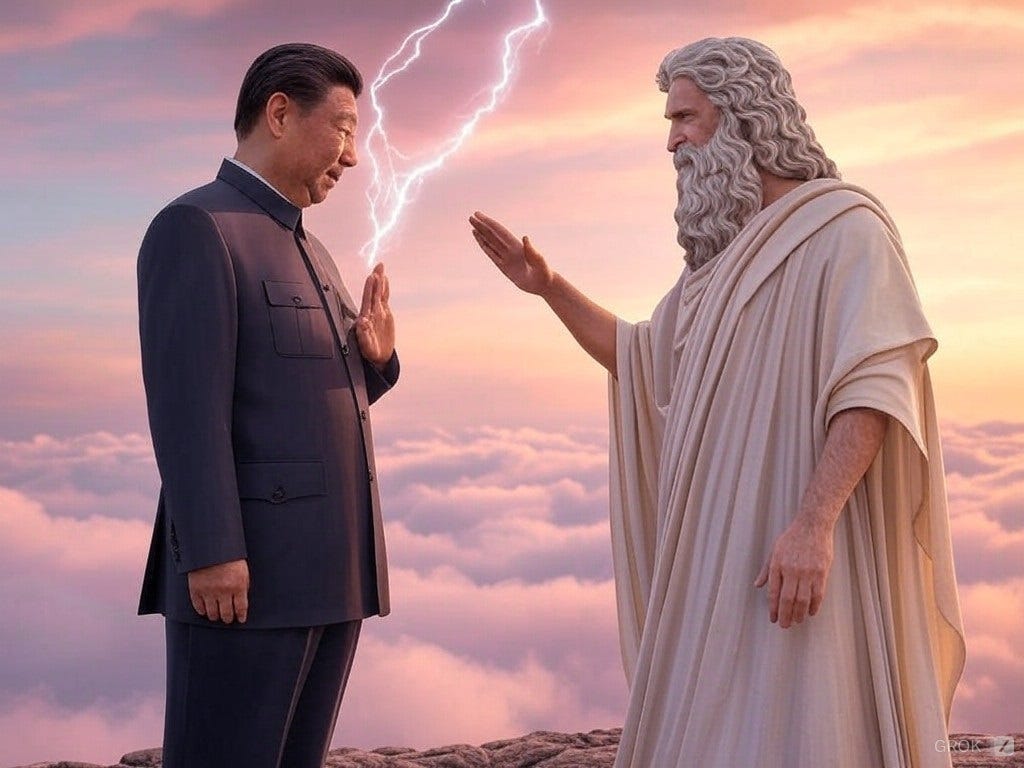
The root cause, I think, is that Americans on both political sides have essentially agreed to frame emerging electrical technologies as being fundamentally about climate change, instead of about national power and prosperity. This is a dangerous misconception. If we don’t stop pigeonholing electrical technology into the climate discourse, it’ll continue to suffer from partisan polarization and misplaced priorities.
“When people stop believing in God, they don’t believe in nothing — they believe in anything.“

At that point, China will have to choose between A) expensive upkeep and redevelopment to keep cities looking new, or B) patching up and painting over old buildings to save money. Japan actually chooses the former, which is why it still looks nice — but this eternal construction and beautification costs a lot of society’s resources. Hong Kong and Taiwan have chosen the latter, and as a result, people gush a lot less about the built environment when they visit those cities these days.
I genuinely feel this might have been one of the strongest factors in undermining my White ingroup sentiment. Consider for a moment the relative ubiquity of “soda” in the Middle American lexicon. Hearing it all the time was sort of like stepping into a parallel dimension where instead of “mom” everyone calls their maternal parent “crobaster.” Could you really think of this realm’s inhabitants as your coethnics in precisely the same way you do momsayers? Even if you tried your damndest, it would really make the other cultural differences stand out.
Cavaliers are the only Northern European ethnic group to genuinely retain a premodern feudal honor culture— cultured southerners will talk about “family honor” in a way that would sound LARPy and bizarre in anyone else’s mouth, but somehow doesn’t in theirs. They also really like to own land, and often have a sort of Crusader Kings attitude about it.
And the thing is even from a self-interested Cavalier perspective that’s clearly for the best, because the Calhoun Mindset really degraded the Jefferson / Lee Mindset, whose fundamental nobility made it far less scalable than cynical quasi-Haitian Calhounism and destined to get outcompeted until the Forrest Mindset emerged to reset the paradigm and pave the way for a Dixie that could productively integrate Cavalier and Borderer values
I mean have any of these class warriors who idolize Vance even read Hillbilly Elegy? This is NOT a book about poor people! It's a book about middle class people who are clearly very smart and creative and energetic but are repeatedly crippled by atrocious executive functioning and insane levels of aggression and impulsiveness seldom observed outside the Dark Continent. I mean Christ—Vance literally says at one point that his folks had a six figure income. His mom was hot and vivacious enough to secure a provider whenever she needed to, and at least one of her brothers was a fairly successful businessman. These people were NOT pathetic helpless victims of avaricious neoliberal politicians. They were a bunch of lazy slutty drug addicts who preferred to live in squalor.
Anyway the point is Vance himself will be fine no matter what. The real tragedy of his situation is that he completely betrayed the message of his book and in doing so massively failed the Scotch-Irish people. He touched on something very real and incredibly important about societal factors that systemically undergird a consistent pattern of personal failing and shitheel niggerish unagentic behavior… and then completely dropped the ball so he could go get rich and then cynically indulge his tribe’s worst impulses the moment Cheeto Benito shows up to serve them comforting platitudes like the Demon Rats do with Black peepo.
You see, technically Bantus are the only group of people that’s entirely human—the rest of us are partly admixed with Neanderthals, and that clearly has impacted our character.
These forces gave the Chosen tremendous power as an ethnic cartel, and at times they deployed this power very cynically to get away with some grotesquely obnoxious shit. But it also got “patched out” over time—first via dilution by way of Shiksappeal miscegenation, then through the horrific overreach of Dubya-era neoconservatism, and finally through the inability of Jews to continue framing themselves as “minorities” in a browning America that increasingly views Israelis as settler colonialists and sees Jews as very White whether they like it or not.
Still another parallel is their obsession with martyrdom, which stands as yet another reason the Irish map well to Ghost Types—these micks constantly talk about dying! Dying in the Potato Famine, dying in the Civil War, dying during the Troubles, dying as part of some railroad gang… you name it and the Irish died doing it.
Anyway the Indians who make it to America clearly aren’t the opening forest lines, and to suggest otherwise would obviously be an unsophisticated Chud Racist take. They’re far more analogous to Safari Zone Bugs like Scyther
Interracial marriage did not cross 50% approval in the US until 1996, when I was 30 years old. Good political messaging drives opinion, it doesn’t follow it.
In U.S. especially, elites always think they’re more salt of the earth than they are. Also: see painting rural gentry as working class.

The second fact that shaped the environment in which Elon became great is elite impunity. Our legal system in fact very rarely dishes out serious consequences to people who can hire great lawyers and are coded as wealthy, white, and entrepreneur
Two years later and Napster was taken down by federal court, and one of the alternatives that users turned to was called Kazaa. Kazaa did not have a centralized server; instead there were so-called "supernodes" — Kazaa users with fast computers and always-on broadband connections — who handled indexing, searches, and facilitated peer-to-peer sharing. Kazaa was also sued, but the battle was trickier, given its decentralized nature; still, the founders saw the writing on the wall and sold out in 2002.
What they retained was their idea of peer-to-peer connections facilitated by supernodes: a year later they launched Skype, which was, in many respects, a voice version of Kazaa.
Two years after that and Skype was acquired by eBay for $2.6 billion, with the idea of making it easy for sellers and buyers to communicate; yes, I promise you, it sounded as stupid then as it does now. eBay changed CEOs a few years later, and Skype was on the chopping block; in 2009 eBay sold Skype to a consortium of investors for $2.75 billion, who flipped the company to Microsoft in 2011 for a jaw-dropping $8.5 billion. This remains one of the most mystifying transactions I've ever seen: not only did Skype's financials not remotely justify that number, there wasn't a strategic angle either, because the iPhone had launched four years earlier.
I don’t see anyone arguing that Silicon Valley innovation is the best way of spreading liberal democratic awesome around the world any more, or for keeping it up and running at home. Instead, I see a variety of arguments for the unbridled benefits of innovation, regardless of its benefits for democratic liberalism. I see a lot of arguments that AI innovation in particular is about to propel us into an incredible new world of human possibilities, provided that it isn’t restrained by DEI, ESG and other such nonsense. Others (or the same people) argue that we need to innovate, innovate, innovate because we are caught in a technological arms race with China, and if we lose, we’re toast. Others (sotto or brutto voce; again, sometimes the same people) - contend innovation isn’t really possible in a world of democratic restraint, and we need new forms of corporate authoritarianism with a side helping of exit, to allow the kinds of advances we really need to transform the world.
But sincere converts to the tech right share at least one thing in common: a belief in founders — change agents capable of upending stale industries — taking on Goliaths, and reaching into the future to unite it to the present. The tech right sees founders, and the qualities they embody and inspire in others, as the key to company success. Conversely, founder-less institutions don’t work, like a body without a head — or perhaps, without a soul.
With its support of Trump, the tech right is just applying this model to politics, the ultimate stale industry, and Washington, D.C., the ultimate Goliath. In Donald Trump, the tech right and the American people see a leader. More to the point, we see a founder.
It's this cultural thing of builders in, prigs out. There are all these memes like “high agency” or “founder mode” or “live players” or “you can just do things.”
That relates to why I see progress as like the primary coalition rather than like left or right. Or as Lonsdale calls it, the “builder class.” There is economic self-interest, obviously, but it’s also an aesthetic preference.
We Are What We Speak: Indo-European Phylogenetic and Linguistic Trees Concur
by Razib Khan's Unsupervised Learning
With this preprint, we confirm that the process of Indo-Europeanization was never a single undifferentiated demographic tidal wave out of the Yamnaya heartland, but multiple distinct migrations, staggered in time and origination point. The first migration, beginning around 3300 BC, seeded Tocharian, an extinct group of languages spoken in what is today Xinjiang, and also sent early outriders who would establish short-lived colonies in Eastern Europe.
Then, waves of the Corded Ware people pulsed out of their core in Poland and Belarus. This was the key Yamnaya daughter culture that expanded after 3000 BC, with descendents reaching the Atlantic by 2500 BC, and the Bay of Bengal by 500 BC (albeit probably having arrived long prior in Punjab, possibly as far back as 1800 BC).
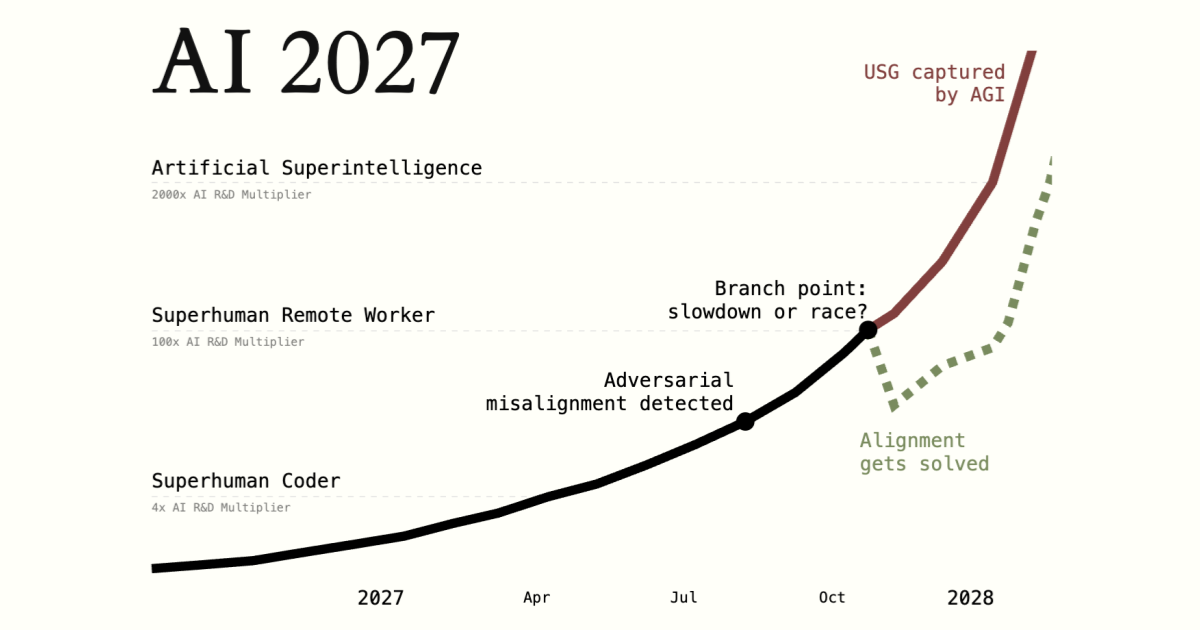
400,000 copies of Agent-5, linked by a global memory bank, work together as a near-perfect hive mind.
Say you live in ancient Egypt, in a period after collapse. You want things to go back to a united kingdom, because right now every piece of land is controlled by the most brutal, they are constantly fighting, food is scarce, and traveling across the land is dangerous because no one trusts outsiders. You notice that others yearn for this too. You believe it’s possible, so you go and make a proposal:
“What if a new king comes! And he unites the kingdom! It’ll bring us to a new golden age!”
This resonates with people. It’s a good story to hold onto in these dark times. They ask you, “What does this new king look like? Tell us so that we can support him when we see him! Everyone currently in charge sucks”
You, of course, don’t know what this hypothetical king looks like, but you can describe properties you would want in a king: “he’s going to be strong, charismatic, he will be fair and just!”
It’s a good story, so people tell it to each other. The story changes as it’s retold, and the versions that are most beautiful AND realistic are the ones that spread. Someone adds a clause for “in his reign, there will be plentiful food and good work for the peasants”.
Do you see where this is going? The prophecy is a decentralized job ad. People vying for power see an opening, but they also see that they’re more likely to succeed if they try to match the prophecy [2] , otherwise the stories spread, “this is not the true king! We await the true king!”

In my teens and early 20s, I was like “whatever, who cares about family”, as I think many people are. Although I think I had an unusually high amount of “who cares”, contrasted with how fondly I thought of my family. But when I was back for the funeral, in some late-night conversations, I came to realize how bizarre the disconnect was between those two stances. “Oh yeah I love my family, they’re great, but I never talk to them.” What? Meanwhile some of my family members were feeling kinda disconnected from me and hadn’t known how to bring it up.
When I was young, my nearby grandparents were a 10 minute drive away (which was a long drive, out of town!) and my faraway grandparents were a 2.5-3h drive away. For my daughter, her nearby grandparents are a 6h flight away (on a hypothetical nonstop flight, which doesn’t even exist), and her faraway grandparents are a 15h flight away. Same with her aunts and uncles. It’s a whole different world. I sense there’s something for all of us to grieve here.
Your twenties still haunt though and so one minute you want to live downtown surrounded by the bustle of a city, people everywhere, never alone. Next you want a chicken farm surrounded by trees and no one.

Compounding Russia's woes is the much more circuitous route that its oil must now take. Prior to 2022, Russian refined oil exports were loaded onto boats in Russian ports like Saint Petersburg and shipped via the Baltic Sea to Canada, around 4,000 nautical miles away. That's a 15-day voyage according to Sea-Distances.
These days, that 15-day voyage has tripled, even quadrupled. First, Russian crude oil must travel from the Baltic to India, a 7,500 nautical mile journey that can take 30 days. That's if it goes through the Suez canal. Passing around the southern tip of Africa amounts to a 12,000 mile trip taking up to 50 days. Once refined in India, the product must travel another 8,000 miles from India to eastern Canada.
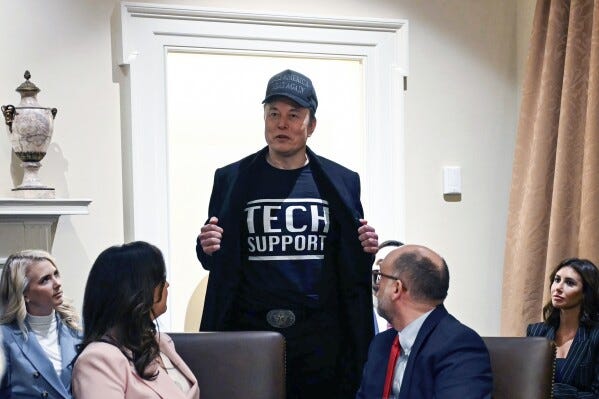
• Many of my early instincts were based on what Vivek Ramaswamy was saying DOGE would be and would focus on. I don’t think I updated quickly enough after Vivek exited — he clearly had a more sophisticated vision than Elon’s. You can argue about whether it’s good or bad, but it was grounded in a particular conservative critique of the administrative state. See the WSJ column by Elon and Vivek (which Vivek wrote and filed himself).
• As the WSJ reported later, the Elon/Vivek split “was… predicated in part by DOGE’s increasing attention on achieving spending cuts, which Musk has championed, and less of a focus on cutting regulations and bureaucracy, which had been helmed by Ramaswamy.”

It’s important to be in the right kind of environment, and around the right kind of people. You want to be around people who have a good feel for the future, will entertain improbable plans, are optimistic, are smart in a creative way, and have a very high idea flux. These sorts of people tend to think without the constraints most people have, not have a lot of filters, and not care too much what other people think.
The best ideas are fragile; most people don’t even start talking about them at all because they sound silly. Perhaps most of all, you want to be around people who don’t make you feel stupid for mentioning a bad idea, and who certainly never feel stupid for doing so themselves.
Outcomes are what count; don’t let good process excuse bad results.

• Most serious conversation about the future takes place at a high level of abstraction, talking about e.g. GDP acceleration, timelines until TAI is affordable, multipolar vs. unipolar takeoff… vignettes are a neglected complementary approach worth exploring.
• Most stories are written backwards. The author begins with some idea of how it will end, and arranges the story to achieve that ending. Reality, by contrast, proceeds from past to future. It isn’t trying to entertain anyone or prove a point in an argument.
It’s useful to focus on adding another zero to whatever you define as your success metric—money, status, impact on the world, or whatever. I am willing to take as much time as needed between projects to find my next thing. But I always want it to be a project that, if successful, will make the rest of my career look like a footnote.
Most people get bogged down in linear opportunities. Be willing to let small opportunities go to focus on potential step changes.
Self-belief is immensely powerful. The most successful people I know believe in themselves almost to the point of delusion.
Self-belief must be balanced with self-awareness. I used to hate criticism of any sort and actively avoided it. Now I try to always listen to it with the assumption that it’s true, and then decide if I want to act on it or not. Truth-seeking is hard and often painful, but it is what separates self-belief from self-delusion.
Self-belief alone is not sufficient—you also have to be able to convince other people of what you believe.
All great careers, to some degree, become sales jobs. You have to evangelize your plans to customers, prospective employees, the press, investors, etc. This requires an inspiring vision, strong communication skills, some degree of charisma, and evidence of execution ability.
My other big sales tip is to show up in person whenever it’s important. When I was first starting out, I was always willing to get on a plane. It was frequently unnecessary, but three times it led to career-making turning points for me that otherwise would have gone the other way.
You have to figure out how to work hard without burning out. People find their own strategies for this, but one that almost always works is to find work you like doing with people you enjoy spending a lot of time with.
One of the best ways to build a network is to develop a reputation for really taking care of the people who work with you. Be overly generous with sharing the upside; it will come back to you 10x.
A particularly valuable part of building a network is to get good at discovering undiscovered talent. Quickly spotting intelligence, drive, and creativity gets much easier with practice. The easiest way to learn is just to meet a lot of people, and keep track of who goes on to impress you and who doesn’t. Remember that you are mostly looking for rate of improvement, and don’t overvalue experience or current accomplishment.
The most successful people I know are primarily internally driven; they do what they do to impress themselves and because they feel compelled to make something happen in the world. After you’ve made enough money to buy whatever you want and gotten enough social status that it stops being fun to get more, this is the only force I know of that will continue to drive you to higher levels of performance.
Even though as you know, I think that profit-seeking enterprises are more moral in the sense that they are accountable to the people they are supposed to serve, whereas non-profits are accountable to donors.
I wish patronage were widely adopted as an explicit social norm. So-called “gentleman scientists” and patron-funded scientists, such as Charles Darwin and Isaac Newton, were behind some of the biggest scientific advancements in the 17th through 19th centuries. I think we got a little confused with the introduction of crowdfunding in the early social media days, which – while certainly a viable funding path – isn’t really the same thing. With time and scale, crowdfunding can feel more like pandering for engagement. I think it has contributed to a lot of the stress that creators feel these days, where they need to aggressively build big audiences in hopes of monetizing a fraction of them.
When you say to a New York Times reader, “Democracy is bad,” they’re a little bit shocked. But when you say to them, “Politics is bad” or even “Populism is bad,” they’re like, Of course, these are horrible things. So when you want to say democracy is not a good system of government, just bridge that immediately to saying populism is not a good system of government, and then you’ll be like, Yes, of course, actually policy and laws should be set by wise experts and people in the courts and lawyers and professors. Then you’ll realize that what you’re actually endorsing is aristocracy rather than democracy.
A hospital stay is a bundle of services. It includes doctor visits, nursing care, meals, lodging, sanitation, etc.
How to Keep Cakes Moist and Cause the Greatest Tragedies of the 20th Century
by Adam Mastroianni

He also gets together with his friends and pretends to be a lion:
Among the features of the Association meetings was the “Red Lion” Club, in which clever buffoonery was freely indulged [...] The governing idea was that its members were really lions, acquainted with one another, who had met by chance, during their prowls, in a town where strange proceedings were in progress. The speakers described what they had witnessed, speaking as it were from a superior and leonine pedestal.
While apprenticing at a hospital, he supplements his daily training by trying every medicine on himself in alphabetical order. He stops after he takes two drops of croton oil and shits himself so bad that he still remembers it fifty years later.

If you start with something you don’t understand, there’s a good chance that soon enough you’ll bump up against something that no one understands.

Weak-link problems are problems where the overall quality depends on how good the worst stuff is. You fix weak-link problems by making the weakest links stronger, or by eliminating them entirely.
Food safety, for example, is a weak-link problem. You don’t want to eat anything that will kill you. That’s why it makes sense for the Food and Drug Administration to inspect processing plants, to set standards, and to ban dangerous foods.
It’s easy to assume that all problems are like this, but they’re not. Some problems are strong-link problems: overall quality depends on how good the best stuff is, and the bad stuff barely matters. Like music, for instance. You listen to the stuff you like the most and ignore the rest. When your favorite band releases a new album, you go “yippee!” When a band you’ve never heard of and wouldn’t like anyway releases a new album, you go…nothing at all, you don’t even know it’s happened. At worst, bad music makes it a little harder for you to find good music
Because music is a strong-link problem, it would be a big mistake to have an FDA for music. Imagine if you could only upload a song to Spotify after you got a degree in musicology, or memorized all the sharps in the key of A-sharp minor, or demonstrated competence with the oboe. Imagine if government inspectors showed up at music studios to ensure that no one was playing out of tune. You’d wipe out most of the great stuff
But if you’re diagnosed with a terminal disease, you’re suddenly in a strong-link problem. An average doctor won’t cut it for you anymore, because average means you die. You need a miracle, and you’re furious at anyone who would stop that from happening: the government for banning drugs that might help you, doctors who refuse to do risky treatments, and a medical establishment that’s more worried about preventing quacks than allowing the best healers to do as they please.
But if you’re diagnosed with a terminal disease, you’re suddenly in a strong-link problem. An average doctor won’t cut it for you anymore, because average means you die. You need a miracle, and you’re furious at anyone who would stop that from happening: the government for banning drugs that might help you, doctors who refuse to do risky treatments, and a medical establishment that’s more worried about preventing quacks than allowing the best healers to do as they please.
most people treat science like it’s a weak-link problem.
Peer reviewing publications and grant proposals, for example, is a massive weak-link intervention. We spend ~15,000 collective years of effort every year trying to prevent bad research from being published. We force scientists to spend huge chunks of time filling out grant applications—most of which will be unsuccessful—because we want to make sure we aren’t wasting our money.
most people treat science like it’s a weak-link problem.
Peer reviewing publications and grant proposals, for example, is a massive weak-link intervention. We spend ~15,000 collective years of effort every year trying to prevent bad research from being published. We force scientists to spend huge chunks of time filling out grant applications—most of which will be unsuccessful—because we want to make sure we aren’t wasting our money.
We should have seen this coming, because the folks doing the strongest-link research have been warning us about it for a long time. One of my favorite genres is “Nobel Prize winner explains how it would be impossible to do their Nobel Prize-winning work today.” For instance, here’s Peter Higgs (Nobel Prize in Physics, 2013):
Today I wouldn’t get an academic job. It’s as simple as that. I don’t think I would be regarded as productive enough.
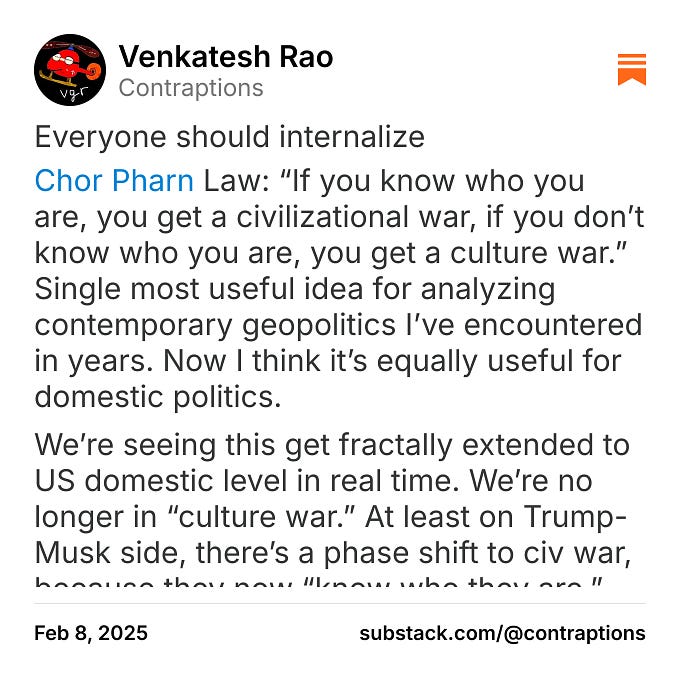
At least on Trump-Musk side, there’s a phase shift to civ war, because they now “know who they are.” Democrats are still figuring out who they are, and so are in an ineffectual, tired culture-war mode. Sitting ducks. Still fighting Trump 1.0.
Chor Pharn Law: “If you know who you are, you get a civilizational war, if you don’t know who you are, you get a culture war.”
Jeff Bezos reminds us to focus on the inputs, not the outputs.
He gives the example of a higher stock price and works backward to the controllable inputs:
“What are the inputs to a higher stock price? Okay, well, free cash flow and return on invested capital are inputs to a higher stock price. Let’s keep working backwards. What are the inputs to free cash flow? And you keep working backwards until you get to something that’s controllable.”

One side monopolizes all the competent people, but uses its power to push a narrow and biased perspective; the other side correctly recognizes that something is wrong, but engulfs itself in a focus on opposition, failing to develop the technical ability to execute on its own.
Another example that comes to mind is the network state movement. Network states are a new strategy for a kind of digital secession, allowing communities that have aligned values to gain some independence from mainstream society and build out their own visions for the future of culture and technology. But the experience of (post-fork) Bitcoin Cash shows that movements organized around forking to resolve problems have a common failure mode: they can end up splitting again and again and never actually managing to cooperate. Bitcoin Cash's experience carries lessons that go far beyond Bitcoin Cash. Like rebel cryptocurrencies, rebel network states need to learn to actually execute and build, and not just hold parties and vibe and share memes comparing modern brutalism to 16th-century European architecture on Twitter.

But this was not a culture war. Rather, America’s conservatives fought a political war over culture. Republicans used cultural issues to gain—or to try to gain—political power. Their brightest minds and greatest efforts went into securing control of judiciary, developing a judicial philosophy for their appointees, securing control of the Capitol, and developing laws that could be implemented in multiple state houses across the nation. No actual attempt to change the culture was attempted.
“preference cascade,” which is Timur Kuran’s term for when people suddenly decide to express beliefs that they were afraid to express before.
Another common pairing seems to be Republican or conservative voters, usually men, dating or married to apolitical or independent women who aren’t affiliated with any party and probably have vaguely generic conservative worldviews when presented with a question about a basic political or social issue. These relationships work because the person who isn’t ideologically affiliated doesn’t worry about how their partner votes because 1. they are usually aligned with whatever opinions they have out loud or just don’t care enough to pay attention and that was probably a subconscious part of them getting along in the first place, and 2. they see politics as just another of their partner’s hobbies more than anything else and regard their partner’s involvement in it like they would video games or woodworking.

Six years after that Fairchild Semiconductor opened a facility in Hong Kong to assemble and test semiconductors. Assembly required manually attaching wires to a semiconductor chip, a labor-intensive and monotonous task that was difficult to do economically with American wages, which ran about $2.50/hour; Hong Kong wages were a tenth of that. Four years later Texas Instruments opened a facility in Taiwan, where wages were $0.19/hour; two years after that Fairchild Semiconductor opened another facility in Singapore, where wages were $0.11/hour.
In other words, you can make the case that the classic story of Silicon Valley isn’t completely honest. Chips did have marginal costs, but that marginal cost was, within single digit years of the founding of Silicon Valley, exported to Asia.
The story of the permaweird over the next decade is going to be the story of these three entangled forces.
Internet-native nomad invasions (née: ethnonational reactionism)
AIs, particularly LLMs
Climate change
THERE ARE DECADES WHEN possibility is constrained in a narrow frame. The terrain has been surveyed, boundaries have been laid, and rules have been established. In such an age there is still room for high drama: The decisive round of a boxing match draws the eye despite the fact—or perhaps because—the boxers play an antique game. In such times and climes, victory means mastery of existing modes, not the invention of new ones.
But nothing human is everlasting. Always there comes a day when spectators search for better games and settlers seek out fresher pastures. That day of change arrives with much confusion and fanfare. Sons dishonor their fathers. Daughters rise against their mothers. Ancestral ideals are cast aside, and possibility staggers forth from its long captivity, ready to wreak vengeance on mankind.
Which is all to say: Cultures do not change when people replace their old ideas with new ones; cultures change when people with new ideas replace the people with old ones. (Many great happenings in human history are decided by such forces—see this essay and this essay for a more detailed explication.)
The Ukraine Blind Spot: How Tribal Politics Obscures a Civilizational Inflection Point
by Patrick Blumenthal

And in 2014, the first test came to Ukraine in the form of "little green men" appearing in Crimea — Russian soldiers without insignia whom Putin explicitly denied were his own troops, even as they seized Ukrainian territory. This wasn't just tactical deception; it was maskirovka — the Russian military doctrine of deception that has shaped their statecraft since the tsars. When Catherine the Great annexed Crimea in 1783, she first sent agents to foment unrest among the Tatars, creating a pretext for "intervention" to protect Russian interests — a playbook of strategic misdirection that endures to this day.
The disconnect becomes clear when you consider how we would view similar arguments about our own history. Imagine foreign observers dismissing the American Revolution as "merely a proxy war between British and French empires," condemning French military aid as needlessly prolonging the conflict, or criticizing Washington for not holding elections during the war. We would instantly recognize such arguments as missing the essential nature of the conflict. Yet when we debate Ukraine, we often lose sight of the local realities and centuries-old struggles that drive events on the ground.

i did not understand why anyone would be upset over the opportunity cost of 10 peanuts. after several minutes of thinking, i understood: middle class people try to optimise for "value for money". if they paid for something, they want to get the most out of it. and if they bought a plane ticket and that entitles you to a free drink and 10 peanuts, they will want to take full advantage of this opportunity. and if they are being robbed of this opportunity, it upsets them.
this is in stark contrast to "abundance mindset" people when i go for dinner with my rich friends, they optimise for "maximum utility" as opposed to "value for money". they would order a dish bc of the meat in there and they would just pick out the parts they like and not touch the remaining food on the plate. it is no problem for them to waste money bc they have a lot more

I don't want to be cynical, but boy oh boy is it hard not to observe that at the very moment in our history when we have the most women in the Senate, Congress is perceived to be pathetic, bickering, easily manipulated and powerless, and I'll risk the blowback and say that those are all stereotypes of women.
Startups are sold to individuals, not to companies. The champion - often a product leader, the CEO, or a general manager - risks their career by buying a startup.
The deal isn’t done until the money is in the bank. I’ve seen acquisitions fall apart the day of close, out of the blue.
Quick Passages

When it comes to money and happiness, there is a glitch in our psychological code."
He argues that this glitch is driven by our flawed extrapolation of the early-in-life happiness gains from increases in incomethat we experience some of the positive impact of money on our well-being as children and young adults and then spend the rest of our lives "[salivating] in anticipation of good feelings when the bell of money rings."
The glitch keeps us on a metaphorical treadmill, always running, never getting anywhere, chasing the early-inlife happiness that money once provided.

When young women insist that men may only ask them out on apps and never in person, it often means: don’t ask me out where other people would observe and judge my reaction, I don’t know how I’m supposed to react!
The best thing about improv is that you can practice it with people who have absolutely no idea it’s happening. Most people most of the time are playing out some scene with tropes and roles and status relationships. You can just “yes, and” and join it. They won’t stop you.
You can practice inhabiting the roles others cast you into or subverting them, creating awkwardness and returning to grace, reveling in conflict or resolving it.

A fire alarm creates common knowledge, in the you-know-I-know sense, that there is a fire; after which it is socially safe to react. When the fire alarm goes off, you know that everyone else knows there is a fire, you know you won’t lose face if you proceed to exit the building.
The fire alarm doesn’t tell us with certainty that a fire is there. In fact, I can’t recall one time in my life when, exiting a building on a fire alarm, there was an actual fire. Really, a fire alarm is weaker evidence of fire than smoke coming from under a door.
It seems to me that this is one of the cases where people have mistaken beliefs about what they believe, like when somebody loudly endorsing their city’s team to win the big game will back down as soon as asked to bet. They haven’t consciously distinguished the rewarding exhilaration of shouting that the team will win, from the feeling of anticipating the team will win.

I don't want to be cynical, but boy oh boy is it hard not to observe that at the very moment in our history when we have the most women in the Senate, Congress is perceived to be pathetic, bickering, easily manipulated and powerless, and I'll risk the blowback and say that those are all stereotypes of women.
I don't want to be cynical, but boy oh boy is it hard not to observe that at the very moment in our history when we have the most women in the Senate, Congress is perceived to be pathetic, bickering, easily manipulated and powerless, and I'll risk the blowback and say that those are all stereotypes of women.
The Kens are not just little boys, but little boys as seen through the eyes of little girls: obsessed with horses and trucks, posturing at each other with “beach offs”, acting out to get mom’s attention, socially naive. They are past the fart-joke stage but, crucially, have not yet entered sexual pubescence. Developmentally, they are perhaps 8-10 years old.
Here it’s worth it to pause and discuss the idea of Straussian reading. People often use it to mean “projecting my own politics on the text”. For others, it means “any reading done by Tyler Cowen”. But Leo Strauss himself laid out profound and very specific insights on the topic, most notably in his seminal Persecution and the Art of Writing.
Strauss claimed that philosophers are always at risk of persecution when their work touches, even obliquely, on the politics of the day. Thus, they strive to convey two meanings simultaneously in their work: an exoteric, surface meaning that kowtows to dominant mores, and an esoteric meaning that contradicts them. They use specific techniques to point at the esoteric, such as creating parallels between seemingly unrelated sections, or leaving deliberate contradictions unaddressed
When Barbie and Gloria return to “patriarchal” Barbie Land, they don’t find out that Ken lied to the Barbies or coerced them. He just asked if they want to trade all their normal responsibilities for beer delivery and they immediately agreed.
But it’s on my mind recently as I try to process everything going on with AI tools, and how quickly they’re getting adopted for creative work. I can’t shake the phrase, “Attractive people with heavily vetted idiosyncrasies” as a description for what AI as a medium wants to produce. (And conversely, the punchline: You want to see a freak? Go to pump.fun.)
In fact, you don’t usually see goths downtown. You see them in quiet malls, in the suburbs, farther out. There are actually lots of country goths, which has become a delightful bit of Americana in tiny rural towns today. Not really cities, though. Goths emerge more naturally under conditions of small numbers of people seeing you all the time, rather than conditions of large numbers of people seeing you a little bit.
If there’s a takeaway lesson from this, I think it’s that parallel interrogation of a creative process leads to boring outcomes; serial investigation gives you creative outcomes.
If you’re a keen observer of political discourse, you at some point realize that there are two kinds of people in the world: those who care about principles, ideas, and humanity, and those who care about definitions.

Pivoting too much. Some startups change their mind too often. They never deliver anything because they’re always changing the direction of the business. Scope creeps. Everything is cluttered. They’re often building multiple things at once. People talk a lot about the idea of “ephemeral apps” these days i.e. products or experiences that only last for a short season. More people should talk about “ephemeral founders” whose focus is so scattered they pivot their companies into the grave.

• A lot more good people have checked out of crypto than you might first realize
. The worst part of all is that none of the spiritual leaders of protocols and chains will speak up to deter this bad behavior because they’ll be crucified by the mob.
Life After A Major Business Exit > A Personal Story of Why (and How) Founders Should Prepare Now
by admin

The one thing I didn’t give myself though is time to just sit and think. It’s a classic entrepreneur mistake, I guess. Fill your time so you don’t have to answer that fundamental question: ‘what do you REALLY want’.
As an exited founder you will be presented with a series of opportunities, some of which are brough to you by others, whilst many more will come from your own head as you get to grips with your new-found entrepreneurial confidence. It is important however to dismiss almost all of them. At least initially.
They say that ‘VC’ is the best MBA you could possibly do

Pieter Levels is literally the most famous person to launch on Product Hunt ever and the guy everyone in our community looks up to. He’s launched 100+ solo SaaS over a decade, makes a few million a year, and is extremely internet-famous (500k+ followers, on Lex Fridman Show, etc.)—yet Product Hunt’s CTO didn’t even know who he was.
Daniel and I sat on the old wicker furniture on my family's enclosed front porch, chain smoking and drinking beers and random cocktails we invented from what we found around the house. We talked about his breakup, my impending one, the universe, beauty, books, feelings, everything that came to mind until the sun came up and we ran out of booze and cigarettes
We were there on my bed on top of the blankets, fully clothed, sweaty, limbs entangled, and we fell immediately asleep, wrapped around each other. When we woke up a few hours later, we were in the same position, barely shifted, one of those sleeping positions you'll never be able to recreate comfortably ever again, only the blissful high of the present circumstances negating the awkward neck positions and the body parts that have fallen asleep with you both.
Daniel was such a cultivated person. Even his handwriting was beautiful and deliberate. He explained his process of deciding on and training himself to write in the way that he did, which I found fascinating.
Daniel's and my relationship was, in retrospect, one of those enormously formative and not uncommon ones for a young woman who is barely out of her teenaged, high school phase of life, and he is not yet 30 but already in a much different stage of life himself, having already cultivated a personality and developed his own mature ethical framework with which to navigate the world. One where he acts as almost an accidental, but inevitable, mentor to her and teaches her about life, what's proper and what isn’t, what makes something beautiful, and how love is supposed to feel.
Unlike Trump’s first term, when nerds were pushed aside, the dork energy of Elon Musk, JD Vance, and Jeff Bezos has merged seamlessly into MAGA-land.

If you wanna do anything cool, you gotta risk being called cringe. Embrace the cringe. One man’s cringe is another man’s cool. As my old boss Greg Isenberg says, “Trying isn’t cringe. Cringe isn’t trying.”
Chiang’s Law, after science fiction writer Ted Chiang who came up with the idea. I tried to reduce it to 12 words:
Science fiction is about strange rules, while fantasy is about special people.
If you know who you are, you get a civilizational war, if you don’t know who you are, you get a culture war.
Boyd Razor:
If your boss asks for loyalty, give him integrity. If your boss asks for integrity, give him loyalty.
Another trait [of great scientists], it took me a while to notice. I noticed the following facts about people who work with the door open or the door closed. I notice that if you have the door to your office closed, you get more work done today and tomorrow, and you are more productive than most. But 10 years later somehow you don't know quite know what problems are worth working on; all the hard work you do is sort of tangential in importance. He who works with the door open gets all kinds of interruptions, but he also occasionally gets clues as to what the world is and what might be important.
One senior executive who was close to him said that the way to succeed at Apple was “do the right thing, and make Steve happy.” In Jobs’ world, there was room for integrity to survive. Room for you to try and do your idea of “the right thing.” In Musk’s world, the razor has apparently degenerated to “Just make Elon happy; he knows what the right thing to do is.” (though it wasn’t always this way).
The most common theories for disease seasonality are:
- Pathogens like the cold
- Pathogens like low humidity
- People are cramped indoors during the winter
- People have low vitamin D during the winter, and vitamin D helps fight pathogens
Robinhood has a history here — it once launched a checking account that also lasted roughly one day before regulators shut it down — but it was a nice try.
One is the standard hilarious American problem that you are not allowed to call the Sper Bwl by its name for commecial purposes unless you pay the National Football League giant gobs of money
Nationalists Already Have the World They Want but Need to Pretend Otherwise
by Richard Hanania
Some people are attracted to tribalism as a moral principle. As with all moral principles, there is a temptation to signal that you adhere to it more than other people.
One memoirist said the question to keep in mind isn’t “Who am I?” but “Who am I in this story?”
He recommends to first “write with the door closed,” meaning your first draft is for you only. Write everything that comes to mind. Don’t edit or backtrack.
“You find yourself constantly questioning your prose and your purpose when what you should probably be doing is writing as fast as the Ginger-bread Man runs, getting that first draft down on paper while the shape of the fossil is still bright and clear in your mind.”
Then, once finished, King says to wait a minimum of six weeks. Then read your whole manuscript in one sitting, if possible.
This is when you “write with the door open,” meaning to shape the story in a way that will be maximally compelling to the reader. Waiting six weeks or more makes it easier to kill your darlings. It’s almost like you’re editing someone else’s work.
The reason we struggle with insecurity is because we are comparing our behind-the-scenes with everyone’s highlight reel.
Is It Better to Bribe Trump by Purchasing His Memecoin or His Stock?
by noreply@blogger.com (JP Koning)

A foreign dignitary looking to gain influence over Donald Trump would like to pay him a giant bribe, but doing so directly is prohibited by all sort of laws. Luckily, Trump has just issued his own memecoin, TRUMP, of which Trump owns 80% of all coins. So why not just buy the TRUMP token, thereby pushing its price up and gifting Trump with even more wealth, in return gaining a degree of influence over policy?
Consider that Donald Trump and family members hold a 59% ownership stake in DJT equity, which isn't too different from the 80% of TRUMP that they own.
The fact that I am even writing a blog post on the topic of bribing an American president shows how far along a certain financial-apocalyptic timeline we have gone.
I asked a manager once if he typically had girls film multiple drips at different times of day, because if you have light pouring through a window for a girl who supposedly lives in a place that’s dark, it’ll be a dead giveaway that it’s not live.
He said no, it doesn’t matter. The men basically never notice or care.
It took a long time for me to come to terms with the fact that for most men, they don’t care about reality when it comes to their supposedly connective porn. They aren’t tracking you for signs of genuine enjoyment; to them, your personality is simply a vessel with which to certify that your breasts are genuine.
You can duplicate an entire human with low resolution and as long as she appears vaguely fertile, they will never notice.
But Onlyfans leadership is ancient and well-versed in the world of porn, hearkening from the primordial internet soup of 2004. This wasn’t a SFW platform that got slowly hijacked by nudes - this was a NSFW website, founded for NSFW creators, owned by seasoned, battle-hardened, semen-crusted company leadership.
That, and I talked to the guy who founded ██████, who told me that Onlyfans was a client, and that the porn ban was certainly an intentional ploy to garner public outrage to help pressure the banks into being less of a little bitch.
Before OF, websites themselves were responsible for providing traffic to their own creators.
By contrast, OF’s internal discovery system is pitiful, mostly limited to a small ‘suggested’ section on the side. I never once heard any OF girl rely on a marketing strategy that involved internal OF discovery systems.
No - instead, OF turns all of its creators into their own ads.
As an aside, I do find this kind of amusing. Getting paid for sex places women into a traditionally masculine role - they become the pursuer, trying to extract something they want from the opposite gender, competing amongst themselves to be the most attractive to otherwise uninterested targets. In a sense, this forced masculine areas of the internet into adopting defensive feminine norms, as they banned any ‘predatory’ behavior and started socially deriding any sellers as being gross or embarrassing.

An ideal to me is to live outside the city when young, try to have a home, a workshop, possessions. You can have the space to accumulate raw materials and tools and knowledge, learn through the works of your hands. Have a place to make babies and give them the materials they need to create, too. Instead of chasing night life, use your time to learn what it is you really like to build.

Occasionally parents might gesture towards an activity, like a lemonade stand on the sidewalk, to gratify a child’s interest. This is the archetypal poor choice: A lemonade stand does not teach the value of money but how to wait and occasionally beg.
Wolf Warriorism: China's Disastrous Attempt at Aggressive Discourse Is Over
by Whipling

In many ways, Wolf Warriorism was no more than Trumpism with Chinese Characteristics.

He says he took ketamine for mild anxiety and it plunged him into an incredibly deep depression that he couldn’t get out of; he leaves his story behind as a warning for others. I appreciate his warning, but I wish he had said more about what dose he used; different people’s ketamine doses vary by almost two orders of magnitude, I’d previously thought that the low doses were pretty safe and the high doses were sketchy, and I would like to know whether I should update or not.
Because I don’t believe in “trust.”
I believe in incentive structures.
Spotify’s rip-offs are made with profiles that look real but are boosted onto playlists to divert listeners away from the actual musicians that make up their platform.
now adult shows will be slop too as characters narrate their own actions and repeat everything twice to make up for lapses in attention as people scroll on their phones.

That’s Bullsht*
Discuss over-hyped arguments, theories, and predictions currently dominating in politics, science and technology discussions. Topics may include American declinism, Chinese ascendancy, yoga, 3D printing, college-via-internet, Bitcoin, Snapchat, kale, drones, paleo diet, meditation, electric cars, and more. Give a 4-minute explanation of what you think is bullshit and why.
That’s Bullsht*
Discuss over-hyped arguments, theories, and predictions currently dominating in politics, science and technology discussions. Topics may include American declinism, Chinese ascendancy, yoga, 3D printing, college-via-internet, Bitcoin, Snapchat, kale, drones, paleo diet, meditation, electric cars, and more. Give a 4-minute explanation of what you think is bullshit and why. Rebuttals encouraged
If you were to write a memoir about a single 72-hour period of your life, which three days would you pick?
What event in your life felt big at the time but didn’t shape your path how you thought it would? What in your current life could prove the same?
What have you fought for more than anything else in your life? Has the fight been worth it?
What vice do you consider a virtue?
What’s a view that you hold that you can’t defend?
• Techno-optimism & pessimism.
• Reinventing democracy for the 21st century.
• Religion in 2100.
• The ethics and morality of torture.
• The future of war.
• Power.
• In what surprising way are you a short-term techno-pessimist, but a long-term techno optimist, and vice versa?
• Which industry is least prepared for the impacts of AI, but surprisingly well positioned to take advantage of it?
• What will be the non-obvious critical inflection points in science and technology in the next year? Ten years?
• What ethical questions related to emerging technologies do you find most impossible to reconcile?
Donald Trump turned down an opportunity to buy the Dallas Cowboys for $50 million in 1984, saying he “felt sorry for the poor guy” who ended up purchasing the team because it was a “no-win situation,”
Chua connected Vance with her agent
My wife goes to Equinox every morning. During classes, the instructors literally shout shit like “DON’T BE AVERAGE” and “THERE’S A REASON YOU’RE HERE AT 6 AM. YOU’RE BETTER THAN EVERYONE”. Equinox appeals to your ego and makes you feel superior.
we signal wealth via visible consumption, instead of via directly showing our asset portfolios or bank accounts
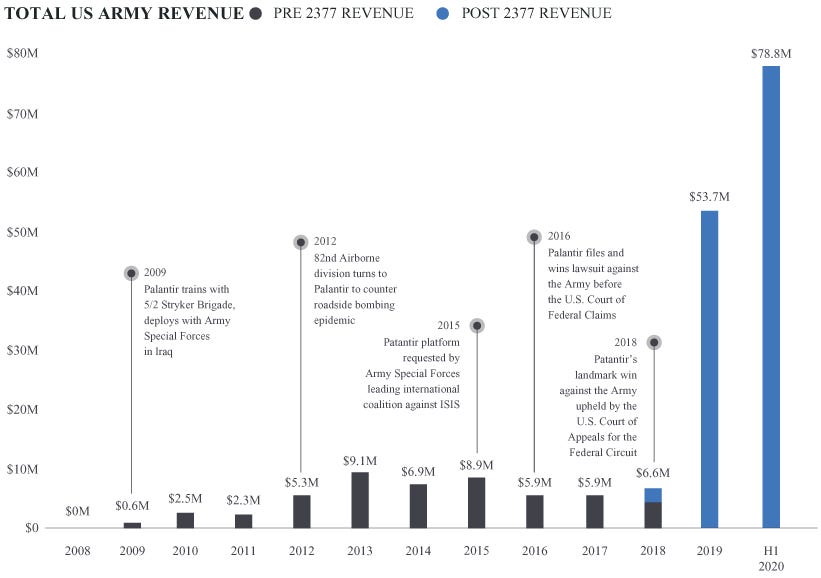
“Cult” is just a euphemism for “ability to pay below-market salaries and get above-average worker retention.”

I think New York is extraordinary in September and October, and it’s extraordinary like April 15 and June 15. But I don’t think it’s particularly compelling, even though I’m in New York right now in the summer or in the winter.
And so. I actually created a distributed life between three core locations where I home a place, and I rotate between them. I’m January, February, typically in Revelstoke, British Columbia, where I work from there during the day, but I’m heli skiing, backcountry skiing, et cetera, in the winter. March, I go back to Turks and Caicos, where I’m working during the day, but at night I’m like reading, writing, meditating, kite surfing, playing tennis, paddle, et cetera.
And then April. May, June, I’m in New York. June, late June to early July, I go to see my family and friends in Nice. Visit uncles, aunts, family, cousins, nephews. I mean, I have a ginormous multi hundred percent family. Go back to my birthday for a few weeks in Turks in August, then go to Revelstoke in, in August to mountain bike rock climb, et cetera, again, working during the day, but doing all these activities at night and the weekends.
In 2023, for instance, the first two weeks of the year, I walked to the South Pole. I do a typically an off-grid category upgrade section every year where I completely disconnected. Usually alone, either doing, I know I crossed Costa Rica on bicycle from the Atlantic, the Pacific, but just my backpack, sleeping bag and tents and water filtration system and learned to start a fire.
And so I have a virtual assistant in the Philippines which I pay 1500 a month who manages a big chunk of my online life, but more than you can imagine like if I’m going to play she’ll like I she knows I love tennis she’ll Fine, she’ll book free.
She’ll identify the best clubs, find partners my level, pre book the lesson, pre book lessons or partners to play with. If I’m in New York, she’ll organize, she’ll look at all the activities there might be for me to do. She knows I like to organize intellectual salons. So, for instance, I’m hosting a post exit founder dinner tonight with like, six sets. Well, eight people total. And I host these intellectual salons in New York. I’m going to like whatever magic shows off Broadway, you name it.
I guess from a work life balance perspective, probably worth mentioning, New York plays the role of intellectual, professional, social, artistic endeavors.
But I’ve come to realize that when you’re doing, you’re not being thoughtful, you’re not being reflective.

What do you say “No” to now that you didn’t say “No” to when you started?
:extract_focal()/http%3A%2F%2Fstatic.nautil.us%2F8884_f96f40bdb8cb393c6e35be1f7464e339.png)
For years culinary detectives have been on the chili pepper’s trail, trying to figure out how a New World import became so firmly rooted in Sichuan, a landlocked province on the southwestern frontier of China.
When ingested, capsaicin triggers pain receptors whose normal evolutionary purpose is to alert the body to dangerous physical heat.
Although Columbus was utterly wrong in his belief that he had sailed to India, he still succeeded in locating precisely what he had been seeking.
What he found was a potent, popular spice—the natives, observed Columbus’ physician Deigo Chanca, included chili pepper with every meal.
Children do not come out of the womb craving a scorching hot cuisine. They’re trained, by their families, to handle the chili’s burn with small doses that gradually increase.
• Adding a TL;DR at the top of the email, no longer than 2 sentences/150 characters.
On the topic of optionality, I always end with: If it’s easier, here’s my cell (XXX)XXX-XXXX.

For Factfulness, it’s easy to do - Hans tells you what it is right at the end. I’m going to start asking what the important facts are, and how many people know them.
If America has problems, it is still morally and culturally superior to the rest of the world. Its destiny is to dissolve borders and distinct cultures, which are annoying and stupid. We do this by welcoming the world here and making it more like us abroad.
Little boys like my son will grow up feeling in their bones that America is big and Europe is small. This is why everyone fears Russia, even though it is weak. It has 11 time zones, and I’m convinced that this has distorted that nation’s psychological profile, making its leaders believe that it is entitled to more of a say in the global system than its level of objective strength and economic development entitle it to.
About 10% are Europeans and the rest are natives.
The Faustian Spirit, as described by Spengler, is the lust for victory above all else and at any cost. It’s a uniquely European cultural attitude stemming from the intersection of relentless ambition, unusual risk appetite, and a boundless appreciation for novelty.

There is no conflict between the Faustian spirit and the contemplative life. The drive to conquest and victory in mental and scientific enterprises has driven Western thought for centuries.
American culture does need more “chillin” and “hanging out.” The greatness of our nation and our heritage is not found in overtime bonuses and a higher GDP. It is found in the quiet moments of reflection that open up a new way of looking at things.

for the cathedral, there are no problems per se, only discourse about problems
it's not important that people are losing their homes, that a city (💫again💫) is burning to the ground. it's important how it's talked about
It started to dawn on me that what I actually wanted was to look like Elon, and that is incredibly cringe. It hurts to even type this out.
We started getting into regular arguments, and I knew it wasn’t on her. It was me. I was starting to come to terms with all the mounting insecurities I had stuffed down over the past several years. I didn’t feel like I could work on them with her. So I broke things off after almost 2 years of unconditional love. It was extremely painful, but it was the right call. I needed to fully face myself.
Then, as the company continued to skyrocket to new heights, I started to have growing expectations for myself, and others started to have growing expectations of me.
Because Britain Gained So Little, Her Commitment to the Peace Was Correspondingly Weak
by Isegoria
France had kept all her ‘natural’ frontiers up to the Rhine and the Alps, retained hegemony over western Europe, and had all her colonies restored to her. Yet in a sense Joseph and Talleyrand had been too successful: because Britain gained so little, her commitment to the peace was correspondingly weak.
OK, so why is India still so poor? All libertarian bias aside, India’s central problem is absurd regulation and state ownership. Absurd how? To start: The Indian government strictly protects legal employees, so 90%+ of Indians work “informally.” Our bus driver to Agra was required to take a rest stop every two hours — in a country packed with tuk-tuk drivers zooming around like maniacs.
Indians often speak of British influence, for good and ill. No one, however, spoke of Soviet influence, which was strong from India’s independence until the USSR’s 1991 collapse. Independent India aped the Soviets’ “Five-Year Plans” until 2017, which probably explains the crazier agricultural policies.

• Film studios now add CGI effects to behind the scenes footage to hide how much CGI has been used to make the film. [Jonas Ussing]
• In Mongolia, people rave on horseback. [Hwang So-hee]
• In the 2020s, over 16% of movies have colons in the title (Like Superman: Man of Steel), up almost 300% since the 1990s. [Daniel Parris]
• Technicians in Taiwan believe that a particular brand of crisps (Kuaikuai (乖乖), coconut butter-flavour) is a good luck charm for technology, preventing computer failures. Packets of Kuaikuai were piled around a model of the Falcon 9 rocket which carried Taiwan’s first domestically developed satellite into orbit. [Noah Buchan]
• In 2024, around 10% of Anguilla’s GDP will come from fees for its .ai domain name. [Benj Edwards]

The Perez Technology Philosophy of History

Thesis: Technology is the dominant driver of history and we can best understand the future by extrapolating technological trends.
The internal combustion engine leads to the car which creates urban structure of the US and suburbs.
The Zeihan Geography and Demographic Philosophy of History
Thesis: Geography is the driver and we can best understand the future by analyzing geography and its implications.
Example: Germany has historically been warlike because it was situated in a hard to defend area between Russia (via Poland) and France. The US has been successful owing to rich natural resources and a highly defensible position with Oceans on either side.
Example: In Europe, the Catholic church changed the rules of inheritance to make it much more difficult for kin groups to pass resources down to their extended families which established it as a separate institution.

If you want to know what the culture of a company is, you could have everyone on the team anonymously complete this fill-in-the-blank exercise.
People who do__________ here get raises, praise and promotions. People who do not do __________ get ignored, chastised, fired, or quit.
Many things become the culture of an organization even without leadership realizing it.
Interestingly, there seems to be a correlation between company success and the CEO’s ability and willingness to do individual contributor-level work well past the point at which it makes economic sense.
• Silicon Valley Venture Capital firm Andreessen Horowitz (A16Z) charges its employees $10 per minute if they’re late at meetings with entrepreneurs (their “customers”).

When someone says “Let’s have a follow up conversation”, what is the implicit unspoken understanding of when that should happen? What will be considered early, appropriate and late in a way that violates cultural norms?

The days are long but the years are short.
What should the receiver do? A generic “help me with advice” is really hard unless you really stand out with #2. The same goes for “Would love your thoughts on my post/startup”. It gets filed into a “todo” bucket as most folks want to send a thoughtful reply…but then never get to it.
Losers are the people who are set in roles or stations in life where the output of their effort is wholly realized by someone else. As they learn throughout their careers, their skill or engagement might lead to incremental career progress, but no real leverage of any kind. Hence, they are “economic losers”, and they know it. They see the world through clear eyes, and cope.
Stanley is a grumpy loser; he treats the entire workday as a “run out the clock situation”. Pam is a cheerful loser; she generally tries to make the best of things, although fully aware of her reality. Darryl is a smart loser; he’s wise to how the world works, and successfully rules over his little kingdom of the warehouse, but generally understands he’s staying where he is.
And finally, the one character who never quite goes over to the dark side but certainly thinks about it (the real will-he-or-won’t-he drama of the show) – Jim.
When people speak back to Michael, Dwight and Andy, they use a different language: Babytalk. Babytalk is the language spoken from the literal, to the clueless
Powertalk (the Sociopaths’ internal language, which is entirely about competitive information-gathering and retroactive deniability), Gametalk (The Losers’ internal language: recurring games or coded rituals to get through the day), and the rare instance where Corporate actually speaks directly with the losers: Straight Talk
Several years ago, Michael Church wrote a neat summary of the American social class system, and how the traditional metaphor of “climbing the ladder of social class” is wrong in an important way. There isn’t one single ladder; there are three – each with different values, norms and goals. You have the first, and largest ladder, Labour. Next, you have the “Educated Gentry” ladder that corresponds to what we typically call the Upper Middle Class. And finally, you have the elite ladder. And the remarkable thing about these ladders is how perfectly they correspond to the three-tiered pyramid in The Office, of the losers, clueless, and sociopaths.
So some examples of Posturetalk (the Educated Gentry talking to anyone; but mostly to each other) include Farmer’s Market Banter (“Praise me for how sustainable I am”), Academia Banter (“Validate my obscure pursuits”) and Blue Check Mark Twitter (“Enshrine my Takes”). Examples of Babytalk (speaking to the Educated Gentry) include Uber Driver Banter (“I’m willing to entertain this conversation but please give me a 5-star rating, I really need it”), Whole Foods Marketing material (“You areso wise for shopping here.”), and Prestige TV (“You are so smart for watching The Good Place”).
War is sparked by egos that are in pursuit of an
Immortality Project.
The Denial of Death introduces this concept of an Immortality Project, which is a mechanism used by the self to ignore the reality of its own mortality.
Becker argues that all things that have had significance in the eyes of history (organizations, movements, empires, cultural narratives, etc.) are immortality projects created by people that wanted to transcend their own material existence.
If you have made your career in finance, you are almost certainly aware that credentialism and its attendant rituals are essential to the smooth generation of fee income.
If I were advising you to draft a fantasy intellectual team, I would argue that the number one pick should be Scott Alexander.
I got an email from Balaji Srinivasan, a man whose anti-corporate-media crusade straddles a previously unrecognized border between endearing and terrifying. He had some very creative suggestions for how to deal with journalists. I'm not sure any of them were especially actionable, at least not while the Geneva Convention remains in effect.
I got emails that were like that, only it was grad students. Apparently if you have a blog about your field, that can make it harder to get or keep a job in academia. I'm not sure what we think we're gaining by ensuring the smartest and best educated people around aren't able to talk openly about the fields they're experts in, but I hope it's worth it.
The other way to feel powerful—the fundamentally onanistic way, for power is so close to sex in the topography of human desire—is what Finkenborg called mimetic kingship. You practice mimetic kingship every time you use the word we—as in, “we should ban skateboarding and drinking from open containers”—when you mean, of course, “the government should ban.” The great Swede dubbed this verb tense the quasi-royal we.
Never Split the Difference
by Chris Voss
They seemed to insinuate that the other side was being dishonest and unfair. And that was enough to make them falter and negotiate with themselves.
There’s the Framing Effect, which demonstrates that people respond differently to the same choice depending on how it is framed (people place greater value on moving from 90 percent to 100 percent—high probability to certainty—than from 45 percent to 55 percent, even though they’re both ten percentage points). Prospect Theory explains why we take unwarranted risks in the face of uncertain losses. And the most famous is Loss Aversion, which shows how people are statistically more likely to act to avert a loss than to achieve an equal gain.
Lately, I have not been feeling quite myself. I live on the internet, which is to say, I am a NEET living in my parents’ basement. In my online persona I pretend that I am ironically pretending to be a NEET living in my parents’ basement, but I am one in actual fact. I believe we are living in the cyberpunk dystopia and it’s way less metal than everyone thought it would be.
The internet is an ocean that we invent as we explore it. The deeper we dive, the more we become cryptozoologists, or crypto-ichthyologists, or even crypto-theologists. In the murky darkness of virtual places, there could be dragons, shoggoths, leviathans; invisible creatures that will prey on us, devour us, or colonize us. Certainly, I have heard voices on the web who say we will discover or build a god when we reach the cyber-ocean floor. That god will save us by authoring an age of post-scarcity economics. It will commodify us, allowing us to be fungible with capital. Amen.
Slicing Pie Handbook
by Mike Moyer

In particular, we found that 73% of teams split the equity within the first month of the startup, at the heights of the uncertainty about their startup’s strategy and business model, their roles in it, and their levels of commitment to it.
Because fixed equity splits stop being fair the moment something changes, nearly every startup has less-than alligators (<) representing people who have less than they deserve, and greater-than alligators (>) representing people who have more than they deserve. Eventually, the less-than people will get upset and want to renegotiate. Everyone becomes poised for a fight. I call these “Alligator Pit” negotiations.
If the company pays you your full market rate you are not putting anything at risk and, therefore, deserve no equity. If the company pays you less than your market rate, then you deserve equity in proportion to the amount that you’re not getting paid.
Therefore, the person who contributes cash to a company is putting more at risk than the person who contributes time or other non-cash contributions
Slicing Pie is used before breakeven. Equity is based on what people put at-risk. After breakeven everyone is getting paid, so equity is no longer about what’s at-risk.
Disagreements with fixed-split allocations often arise when members of the team are added or subtracted, or the work product of individual participants differs from what the team originally anticipated.
The recovery framework tells you what to do when someone leaves the company. In some cases, the company will be able to recover outstanding slices for no or low cost; in other cases, the person leaving will be entitled to keep their share or sell it back at a fair premium. It depends on the nature of the separation. The recovery framework ensures that each participant understands the consequences of their decisions as they relate to ongoing participation in the firm.
So, if you forego that salary to work for a startup (doing similar work), you are betting that amount of money. The opportunity cost of working for a startup is equal to the amount of money you would have earned elsewhere doing a similar job.
The only reason a rational person would be willing to join a startup and accept this risk is if they believe that their ultimate compensation will far exceed the amount they would otherwise get paid.
The only real certainty you get from a fixed split is the certainty that you will have to renegotiate your split when something doesn’t go as planned!
Cash is given a higher premium because it’s much harder to save money than it is to earn money.
If you’re dealing with actual cash, then the fair market value is equal to the amount of cash spent. If the cash isn’t spent, it’s not at risk
This is the part of the program that some people find concerning (sometimes). The first thing that people don’t like about this calculation is the thought of tracking their time. Most people, including me, don’t like tracking their time. However, few things will give you better insight into what is going on with your startup company than a time report.
Those francs don't represent value you've extracted from the Congolese economy. Just the opposite: they represent value you've delivered to it, through your window.
Imagine a particular bag of grain that you bought at T1 for 200 francs, and then sold a month later, at T2, for 800 francs. What changed in this interval was the relative scarcity of grain. At T1 the grain was abundant (and therefore cheap), but at T2 it had become scarce (and therefore expensive).
What happened is that you effectively time-shifted the grain.
We earn money by providing value to other people. And consequently,
The money you've earned represents value you've contributed to society.
Often a species most important competitor is itself.
Wherever we find a tall organism, we can reasonably infer that it evolved in an ancestral environment with other tall things.
And we had to earn these things, in part, by out-witting and out-shining our rivals.
It's in that struggle that we, like the redwoods, developed some of our most distinctive characteristics.
In seeking to understand particular forms of human behavior, especially social behavior, it often pays to look for analogues elsewhere in the animal kingdom.
The beginning of wisdom about social status is learning to distinguish its two (and only two) primary forms: dominance and prestige.
If dominance is the kind of status we get from intimidating others, prestige is the kind of status we get from doing impressive things or having impressive traits or skills.
Avoidance vs. approach. Dominance works by inspiring fear and other "avoidance" instincts, so that low-status people try to steer clear of dominant individuals. Prestige, on the other hand, inspires admiration and other "approach" instincts, so low-status people actively seek out prestigious individuals and enjoy spending time around them.
Taking vs. giving. The perks of dominance are taken by force by the high-status (dominant) individual. The perks of prestige, on the other hand, are given to the high-status (prestigious) individual, freely, by the low-status admirer.
Entitlement vs. gratitude. Dominant individuals expect deference from others and treat it as their natural right. Prestigious individuals, on the other hand, often make an elaborate show of humility when accepting the deference of others
In contexts governed by dominance, gazing at someone is considered a threat, an act of aggression. so instead they resort to "stealing" quick, furtive glances. You can think of personal information as the key resource that the dominant individual tries to monopolize for himself. He uses his eyes to soak up personal info about the other members of the group, but tries to prevent others from gleaning info about him. In contexts governed by prestige, on the other hand, gaze is considered a gift; to look at someone is to elevate him.
In this case, attention (rather than information) is the key resource. Prestigious people compete for attention ("Look at me!"), and admirers oblige by "paying" attention, as freely and happily as they pay for any other good or service
With that in mind, what follows is the most important thing I hope you'll take away from this essay:
To understand dominance, we need to focus on the high-status behaviors. To understand prestige, however, we need to focus on the low-status behaviors.
Bottom line: Prestige-seeking and admiration (deference) are complementary teaming instincts.
prestige reflects your value as a teammate, whether actual or potential.
Why did prestige status take off so spectacularly in our own species (rather than, say, any of the other great apes)?
it was the fact that our ancestors lived in a semi-permanent "home base" that needed to be guarded collectively
our ancestors gravitated toward prestige status because, once we learned to use tools as weapons, the dominance system completely collapsed
There's another reason babblers defer to those with high prestige. Prestige acts as fitness display, a demonstration of one's health, vigor, and strength, and therefore one's potential for dominance.
Prestige-seeking must therefore have as its goal something more than proving one's capacity for dominance.
a loser seeking to overturn a democratically decided election. In fact, a variation on the theme occurred once before in American history, Burr Conspiracy, of 1804-1807
Guilt by association is a relatively modern concept. Back in the olden days, people were free to fraternize with criminals and terrorists, as that was our First Amendment right.
This was primarily a consequence of the unreasonable burden of trying to police such activity. A self-interested government tries to maximize economic output, to generate more tax dollars to pilfer. A ban on doing business with Bad Guys imposes transaction costs, as every business would have to conduct a background check before accepting a customer.
By 1970, it was no longer unreasonable to expect banks to record the source of customer funds. So money laundering laws were invented to create Guilt by Association. It costs nothing to deputize the banks, and the War on Drugs is more important than our First, Fourth, and Fifth Amendment rights.
Anything that can be deputized will be deputized.
That was the justification for the NSA’s warrantless wiretapping after 9/11. We were outraged when word first got out, but now it’s accepted as a part of life. In fact, we literally demand that social media platforms police people who think Bad Thoughts.
Things you use for a significant fraction of your life (bed: 1/3rd, office-chair: 1/4th) are worth investing in.
“Where is the good knife?” If you’re looking for your good X, you have bad Xs. Throw those out.
When buying things, time and money trade-off against each other. If you’re low on money, take more time to find deals. If you’re low on time, stop looking for great deals and just buy things quickly online.
How you spend every day is how you spend your life.
Noticing biases in others is easy, noticing biases in yourself is hard. However, it has much higher pay-off.
Deficiencies do not make you special. The older you get, the more your inability to cook will be a red flag for people.
- Keep your identity small. “I’m not the kind of person who does things like that” is not an explanation, it’s a trap. It prevents nerds from working out and men from dancing.
- Don’t confuse ‘doing a thing because I like it’ with ‘doing a thing because I want to be seen as the sort of person who does such things’
Procrastination comes naturally, so apply it to bad things. “I want to hurt myself right now. I’ll do it in an hour.” “I want a smoke now, so in half an hour I’ll go have a smoke.” Then repeat. Much like our good plans fall apart while we delay them, so can our bad plans.
When you ask people, “What’s your favorite book / movie / band?” and they stumble, ask them instead what book / movie / band they’re currently enjoying most. They’ll almost always have one and be able to talk about it.
You have vanishingly little political influence and every thought you spend on politics will probably come to nothing. Consider building things instead, or at least going for a walk.
Some types of sophistication won’t make you enjoy the object more, they’ll make you enjoy it less. For example, wine snobs don’t enjoy wine twice as much as you, they’re more keenly aware of how most wine isn’t good enough. Avoid sophistication that diminishes your enjoyment.
Afforded the mountains of leisure time and resources dreamt of only by Trotskyists, hundreds of thousands of furloughed logistics coordinators, bank clerks, shop assistants, marketing agents, business development managers and telephone operators fail to rise to the heights of Aristotle, Goethe, or Marx.
American conservatism is represented by a twice-divorced reality television star from the nouveau riche.
We seem to have discovered that empires have certain advantages, particularly in the field of commerce, and in the establishment of peace and security in vast areas of the globe. Perhaps we should also include the spread of varied cultures to many races.
The present infatuation for independence for ever smaller and smaller units will eventually doubtless be succeeded by new international empires.
The present attempts to create a European community may be regarded as a practical endeavour to constitute a new super-power, in spite of the fragmentation resulting from the craze for independence. If it succeeds, some of the local independencies will have to be sacrificed. If it fails, the same result may be attained by military conquest, or by the partition of Europe between rival super-powers.
Here I look for specificity of thought and curiosity. Balaji Srinivasan and Chris Dixon call it spending time in the idea maze. While the best founders spend time in that maze, they’ll eventually stumble across their earned secrets. Secrets that they’ve learned through hell and back. Through blood, sweat, and tears. Secrets they know that others won’t know if they’ve never been in the weeds.
The ‘Great Transformation’ in and of itself is the painful process a society must go through to imagine and set up these indispensable institutions—a process that includes softer ways, like elections and collective bargaining, but also more destructive paths, like fascism and war.
What Polanyi describes in his book is in fact the long economic transition between two very different worlds. One is the 19th century gold standard economy, whose prosperity culminated in the US during the Gilded Age. The other is the 20th century Fordist economy that only found its balance—and entered its Golden Age
The key institutions that rendered the market system sustainable in the gold standard economy were free trade, the occasional military conflict that took place within the Concert of Europe, and obviously the gold standard itself—which made Western exporting firms confident that the currencies they earned would be as “good as gold”.
haute finance, the trade of bankers such as the Rothschilds and later J.P. Morgan, which in a world deprived of international organizations “functioned as a permanent agency of the most elastic kind”
Sometime at the end of the 19th century the gold standard economic order began to unravel. At work was the rise of various forms of protectionism, from tariff barriers to colonial empires, which in turn triggered the breakdown of the gold standard.
In Polanyi’s suggestive words (written in 1944),A country approaching the fascist phase showed [common] symptoms, among [them] the spread of irrationalistic philosophies, racialist aesthetics, anticapitalistic demagogy, heterodox currency views, criticism of the party system, widespread disparagement of the “regime,” or whatever was the name given to the existing democratic setup… These are the bare outlines of a complex picture in which room would have to be made for figures as diverse as the Catholic freelance demagogue in industrial Detroit [antisemitic Catholic priest Charles Coughlin], the “Kingfish” in backward Louisiana, Japanese Army conspirators, and Ukrainian anti-Soviet saboteurs. Fascism was an ever-given political possibility, an almost instantaneous emotional reaction in every industrial community since the 1930s.
Work itself is undergoing radical change through what many deem “platform capitalism”.
ISIS-sponsored terrorism may very well be to our digital world what the Nazi regime came to be in the troubled and unbalanced Fordist world from 1933 onwards.
ike the gold standard in its time, the EU was designed precisely to provide stability and security at the macroeconomic level. In that regard, much like the UK getting off the gold standard in 1931, Brexit is only one more episode of the old economic order unraveling before our eyes—and yet one more proof that Europe is undergoing a Polanyi moment.
it leads to tracing another dividing line, this time between the rare elite representatives that are looking forward (Bill Clinton and Al Gore in their time, Barack Obama) and the dominant majority among them that don’t realize the transition at work and keep on looking backward (Donald Trump, Bernie Sanders).
The rise of fascism is consistent with the blurring of political lines. If the difference between left and right becomes less obvious, then the political mood creates an opportunity for fascist politicians to try and have it both ways: being both a strict father (‘National’) and nurturant parents (‘Socialist’) at the same time.
Hence fascists are hard to identify with either the left or the right: the opportunity they seize is that of the transition and the despair of all those, left and right, who are looking backward in the hope that everything will go back to the way it used to be. On a backward/forward axis, things are clearer, as fascism clearly stands for the restoration of the past, mythified power and prosperity: think Mussolini and the Roman Empire, Hitler and the pre-Versailles Treaty Germany. Indeed the “Make America Great Again” tagline is one hint, among many, that leads some to wonder if Donald Trump is in fact a fascist.
But mostly they grabbed the upside of the war effort: not only peace at home, with the opportunity to set up social institutions earlier than other Western countries, but also superpower status, economic growth, a radical upheaval of their productive system, and an unprecedented drive in the field of high-technology research—which, by the way, gave birth to Silicon Valley.
On the one hand, the continent could further sink into its current problems, made even worse by the difficulty of arriving at decisions in a 27-member organization (structural problem), the Brexit-triggered crisis (contingent problem), and the permanent temptation of European elites to ignore the transition and to defend the status quo (fundamental problems)
Another advantage derives from the strength (and the distinguishing feature) of the British: their sincere liberalism. Liberal values were always affirmed throughout British history as they went hand-in-hand with the country’s strategy of power: maritime power yesterday, financial power today.
The country’s challenge is now to not renounce liberalism but instead to develop new institutions that allow for the digital economy to become more inclusive.
The plebeians became irrelevant to the political system, which they were not under the Republic, becoming merely pacified with the famous bread and circuses—also a bad change, since every society should have every level of society invested in it.
Twentieth-century conservatives’ devotion to unregulated markets and libertarianism has now contributed to a series of financial crises, the loss of U.S. manufacturing, and a completely demoralized society. Yet many conservatives continue to speak as though libertarianism is the solution.
Henry Luce, the co-founder of Time Magazine, had a simple philosophy: "Tell the history of our time through the people who make it." This is exactly what Walter Isaacson has done through his writing life.
Leadership is 90% compromise and 10% taking a firm stand on important principles.
It's easier to accomplish things when you don't worry about who gets the credit.
The Real Story of the Dutch Tulip Bubble Is Even More Fascinating Than the Myth You’ve Heard
by barrons.com
The plague did, however, play a role in creating the tulip bubble in a different way, Goldgar says.
“There were people who had a bit more cash because they had acquired some extra money from relatives who had died.”
To put it simply: certain people had some disposable income to spend—on tulips.
The plague did, however, play a role in creating the tulip bubble in a different way, Goldgar says.
“There were people who had a bit more cash because they had acquired some extra money from relatives who had died.”
To put it simply: certain people had some disposable income to spend—on tulips.
Which ideas shape society? Why have ideas and systems such as ‘Christianity’, ‘natural selection’, ‘Marxism’ or ‘general relativity’ been so influential?
A myriad of answers have been proposed, ranging from the “marketplace of ideas” to Hegelian dialectics to top-down narrative management to the arc of moral progress, and more.
Anyone who hopes to change society through their ideas bases this hope on an answer to this question. The success of such plans depends on getting the right answer.
“We” didn’t want Uber or Airbnb, but we got them anyway because they were built in spite of regulation, and now “we” can’t live without them. I’m not sure a strategy of civil disobedience scales for other sectors, but a during a pandemic may well be an appropriate time to ask for forgiveness rather than seek permission.
The Bear's Lair: Are We Watching the End of Julian the Apostate? | True Blue Will Never Stain
by tbwns.com
From AD 361 to 363 (AUC 1114 to 1116, to use the calendar Julian would undoubtedly have preferred) he was a popular and successful Roman Emperor, attempting to reverse novel elite beliefs that he thought destructive and “Make Rome Great Again.” He was killed unexpectedly, and Rome’s decline followed quickly and inexorably, although the destructive beliefs he opposed survived for millennia. Does the obvious analogy to Donald Trump hold water?
Impressive churches were established, notably St. Peter’s in Rome and the Church of the Holy Apostles in the new capital of Constantinople, and heavy tithes were imposed on the populace to pay for them, depressing the economy
Fanatical Imperially-supported Bishops of various Church denominations led vicious campaigns against the old religion and its believers, turning the majority of the Roman people into “deplorables.”
A more important long-term problem was that the Christianization of the Empire blocked the possibility of Roman citizenship for “barbarian” tribes around Rome’s borders who had not converted.
The Dark Ages inexorably followed, and Christian monks wrote the history, so Christianity’s responsibility for the collapse of Roman power was carefully glossed over.
Signaling, however, grows stronger the larger the out-group is – as long as the out-group knows about the in-group. This is why luxury car manufacturers deliberately extend their advertising campaigns to people who will never be able to afford their cars: they are increasing the size of the out-group by educating people about the in-group.
Loyalty means giving preferential treatment. If I am loyal to you, then when you say “jump” I ask “how high?” When someone else says “jump” I ask “why?”
Heidi wants to avoid treating anyone preferentially. But that would mean having no loyalty. Or being loyal in a very abstract sense, to principles. There is something to be said for this stance, if it could only work.
I would bet that the chances that you are a bad, exploitative person are much less if you work at a profit-seeking firm than at a non-profit. Within a profit-seeking firm, I would also bet that the chances that you are a bad, exploitative person are much less if you have a stake in the enterprise as a whole than if you are highly compensated based on individual performance. To be clear, what I am saying is that the non-profit sector is more likely to unintentionally select for bad people than is the for-profit sector. And within the for-profit sector, high compensation without skin in the overall game is more likely to unintentionally select for bad people than is an ownership stake in the overall enterprise.
“He owned a jacket, a book that he could trade for another, and a flock of sheep. But, most important, he was able every day to live out his dream. If he were to tire of the Andalusian fields, he could sell his sheep and go to sea. By the time he had had enough of the sea, he would already have known other cities, other women, and other chances to be happy. I couldn’t have found God in the seminary, he thought, as he looked at the sunrise.” – The Alchemist, Paulo Coehlo
Traveling in this fashion is primarily fueled by Travel Guilt or the sense that you’ll have wasted your trip if you don’t do every single thing available to you in a location.
Part of travel guilt and comes from the notion that you have to see everything, but once you realize and accept that you’re unlikely to see even 1% of the beauty in the world before you die, it’s much easier to relax and enjoy where you are.
And when that’s how you’re operating, the solution isn’t more freedom and novelty, it’s resetting your priorities.
They all came from investment and cultivation, not from novelty.
It’s easy to get caught up in the pursuit of greener grass through more money, travel, sex, experiences, people, whatever you believe will bring you to that next level of bliss, but in most cases, the grass is greener where you water it. It’s not about trying to find that 99% perfect city, person, project, lifestyle, but about finding ones that are 80-90% of the way there and then investing in them to make them great.
“I believe that evolution, which is the natural movement toward better adaptation, is the greatest single force in the universe, and that it is good.” – Principles, Ray Dalio
Hitler's conviction that a new Eurasian order should be constructed with Germany at its zenith had its ideological roots in the early science of geopolitics.
The military conquests of Hitler’s Germany have often been explained as a reaction to the ‘dictated’ settlement of Versailles, or as a product of Hitler’s own fantastic ambitions for world domination. They are much better understood as a classic example of geopolitical calculation, and a manifestation of the broader influence of early 20th-century geopolitical discourse in stimulating and legitimising territorial expansion.
The key to understanding the strategies pursued during the Hitler dictatorship is the concept of ‘territoriality’ – a concern with Raum, a word usually rendered not very successfully in English as ‘space’.
Concern with adequate space also reflected the insecurity felt by German politicians and intellectuals that Germany had arrived too late to share properly in the spoils of European overseas empire. Although Germany was allowed limited colonial claims in Africa and the Pacific, the imperial project was limited in comparison with the British Empire, the model for German imperialists of the relationship between geography and politics, space and power, and in the 1920s and 1930s a model for Hitler and the National Socialist leadershi
Hitler’s famous comment that ‘Russia will be our India’, though it revealed how little he understood British imperialism, also revealed the extent to which the German project was seen as an extension of an existing geopolitical reality.
If we think about a company as an organism, then a knowledge management system is essentially the (collective) brain that keeps that organism alive and running.
Information should be easy to add (input) as well as easy to search and find (output) resulting in quick knowledge transfer between different employees.
As anyone who has ever worked at a larger company can attest to, company knowledge bases always end up being a huge mess.
It seems like things usually start to fall apart once a company surpasses the Dunbar number of 150 employees. This is probably when people start to realize that all the different documents of explicit knowledge they were amassing over the years have been held together with implicit knowledge.
The idea behind tools like Notion is to solve this problem by using just one tool for all your different knowledge documents. Instead of Google Docs AND Asana AND Trello AND Airtable, you just do everything in Notion.
The folder structure of your Google Drive, for example, doesn’t really matter because looking up documents via search is faster and more convenient.
<em>Apocalypse Never: Why Environmental Alarmism Hurts Us All</Em> (Michael Shellenberger) • the Worthy House
by theworthyhouse.com
Rather, for the media, the mouthpiece of the Left, the invocation of supposed experts has become an incantation, one that wholly substitutes for reason and by its magic keeps at bay the night, dark and full of terrors.
A running theme in all of these essays is the importance of seeing individual authors not as individual authors, but as voices in a chorus. No writer is an island. If a "public voice" is inspired to spend hours massaging paragraphs and digging up references, it is because she has something to prove, and more important still, someone to prove it t
A running theme in all of these essays is the importance of seeing individual authors not as individual authors, but as voices in a chorus. No writer is an island. If a "public voice" is inspired to spend hours massaging paragraphs and digging up references, it is because she has something to prove, and more important still, someone to prove it t
Substack is the medium of the solo artist. High-rolling soloists at that. Like Patreon, Onlyfans, book publishing generally, or any other medium where creators connect with the masses sans bundled packaging, Substack has (and will continue to have) a power-law distribution.
The current intellectual sphere (centered on Twitter) makes interaction even easier. Its cost is an eroding sense of community. The borders between different blogging communities were permeable, but they were borders. On Twitter everyone and everything is tossed together in one great jumble.
» Ethics in Strategy Gaming, Part 1: Panzer General the Digital Antiquarian
by filfre.net
And yet in Panzer General we have a mass-market American computer game in which you play a willing tool of Adolf Hitler’s evil, complete with all the flag-waving enthusiasm we might expect to see bestowed upon an American general in the same conflict.
The occasional reports which reached the Allied countries of the horrors of the Holocaust during the early and middle years of World War II were widely dismissed, unfortunately but perhaps understandably, as gross exaggerations. But when American and British armies finally began to liberate the first of the concentration camps in late 1944, those reports’ veracity could no longer be denied. General Dwight D. Eisenhower, the supreme commander of the Allied forces attacking Germany from the west, made it a point to bear witness to what had taken place in the camps. He ordered that all of his men should pass through one or more of them: “We are told the American soldier does not know what he is fighting for. Now, at least, we know what he is fighting against.”
The historian Harold Marcuse names “ignorance, resistance, and victimization” as the myth’s core components. It claims that the crimes of the Holocaust were entirely the work of an evil inner cabal that was close to Hitler personally, that the vast majority of Germans — the so-called “good Germans” — never even realized any of it was happening, and that most of those who did stumble across the truth were appropriately horrified and outraged. But in the end, as the reasoning goes, they were Hitler’s victims as well, unable to do much of anything about it if they didn’t want to suffer the same fate as the people already in the concentration camps
The myth of the “clean Wehrmacht” held that the vast majority of German officers and soldiers were in fact no more guilty than the soldiers of the Allied armies. Most or all of the German war crimes, so the reasoning went, were the work of the dreaded SS Einsatzgruppen who traveled just behind the regular army units, maiming, torturing, raping, and massacring civilians in staggering numbers.
For all its patent weaknesses as an argument, the clean Wehrmacht would become a bedrock of a new strand of historical writing as well as a culture of wargaming that would be tightly coupled to it — the same culture that would eventually yield Panzer General.
The North African front was a clean one by the standards of almost any other theater of World War II; it was largely a war of army against army, with civilians pushed to the sidelines. Thus it would go down in legend as “the war without hate,” a term coined by Rommel himself. This was war as wargamers would later wish it could always be: mobile armies duking it out in unobstructed desert terrain, a situation with room for all kinds of tactical give-and-take and noble derring-do, far removed from all that messiness of the Holocaust and the savagery of the Eastern Front.
Rommel became a success out of all keeping with any normal military biography upon its publication in Britain, then an equally big bestseller in the United States upon its publication there one year later.
Rommel made a regular habit of outrunning his supply chains in North Africa. “The desert,” he said, “is a tactician’s paradise and a quartermaster’s hell” — but he did nothing to make his quartermaster’s job easier. When his army ran out of fuel or bullets, he started by blaming his subordinates, then moved on to blaming the Italian navy, which was in fact delivering more supplies than his army actually required most days, only to watch them pile up on the wharves of the Middle East’s port cities for want of a way to transport them inland to an army that had burrowed too deeply too quickly into the enemy’s territory.
Rommel’s men may have loved him, but his peers in the hierarchy of the Wehrmacht had little use for him for the most part, considering him a glory hound whose high-profile commands were mostly down to his friendship with Joseph Goebbels.
They pointed out that his much-vaunted habit of standing with his men on the front lines during battles, pistol in hand like a latter-day Napoleon, made it impossible for him to observe the bigger tactical picture. There was a reason that most other generals of the war stayed in their headquarters tents well back from the front, right next to a junction box of telephone cables — and this reason had nothing to do with personal cowardice, as some Rommel boosters would have you believe.
“It is well that war is so terrible,” said Robert E. Lee, famously if apocryphally. “Otherwise we would grow too fond of it.”
People who are pacifists always talk about how terrible war is because it is so bloody and violent and wasteful. What they’re not getting is that people who like war — or don’t dislike war — admit all that; they know all that. It’s very obvious, but for them it’s worth it because of the stimulation, as they see it, to human greatness.
And finally, it introduced the wargame cliché of the “Rommel unit”: a unit whose commander is such a superhero that he can break the rules that usually govern the game by sheer force of will.
“the focus on Rommel and more generally the German side (many wargames feature prominent German military motifs and use German military nomenclature) cater to a genre that customarily finds more interest in playing the underdog, relying on [the player’s] brains rather than overwhelming force, and accepting the challenge of reversing the historical result.”
The game studiously avoids swastikas. In popular culture, the swastika has come to stand for the Gestapo, SS, and other “bad” Nazis, while the older iconography of the Iron Cross or eagle wings stands in for the “clean” Wehrmacht. But the real distinction is, as we’ve seen, less clear-cut than many would like it to be.
My hope is that now that the election is over there is room to be a bit more clear-eyed on these questions. My fear, however, is that the Biden administration will succumb to the sore temptation to abandon any genuine good done over the last four simply because a Trump official was the one who do it. An evenhanded evaluation of the Trump era’s mistakes and accomplishments in this domain is needed, so that new the administration may jettison less helpful schemes without throwing out the policies that increased America's credibility and leverage in the region.
Stern observes that while Obama had a declared commitment to Asia and seemed destined to be the harbinger of a new Pacific order, his administration's foreign policy was tradition-bound, wedded by ideology and personal style to the values, institutions, issue sets, and personalities of the transatlantic relationship.
The Trump administration, in contrast, made a point of seeking Japanese input on all aspects of China and North Korea policy, both at the level of the President and those a few rungs below him.
In two years Trump had quadruple the personal contact with Prime Minister Abe than Obama had during his two terms as President.
The Bear's Lair: The Emerging Global One-Party State | True Blue Will Never Stain
by tbwns.com
Politics, as always, messes up the process; once you take account of politics, it becomes clear that extreme globalization must be fought tooth and nail.
Global GDP per capita, the growth of which should have accelerated after 1990, as full globalization and the Internet/telecom revolution took hold, has in fact slowed. Whereas in the 30-year period 1960-90, growth averaged 1.25% per annum, on World Bank figures, in the 28-year period 1990 to 2018 it has averaged only 1.15% per annum.
The Bear's Lair: Philip II’s Lessons for America | True Blue Will Never Stain
by tbwns.com
The problem was not Philip II’s revenues, but his expenses. Having decided that he was Europe’s only reliable protector of Catholicism (of which he was a dour and fanatical adherent) he engaged in an expensive albeit successful naval war against the Ottoman Empire, a prolonged intervention in France’s 40-year Wars of Religion, an 80-year attempt to prevent the Protestant Netherlands claiming independence and an entirely unnecessary, expensive and unsuccessful 15-year war against England’s relatively pacific Elizabeth I.
Since this column appears on the 413th anniversary of Guy Fawkes’ attempt to blow up the Houses of Parliament, I thought it worth reflecting on why he got so close. The principal reason was the parlous state of early Stuart finances, which was due to two factors: the lack of a central bank and the lack of a reliable government bond market.
The reason for the Parliamentary sitting which Guy Fawkes attempted to blow up was that James I was being forced to go to Parliament and beg for money, since his traditional revenues were inadequate for his needs (they were mostly set at nominal amounts, and inflation had reduced the value of money by three quarters in the previous century.) It wasn’t the military-industrial complex that forced him to do this; James I, the most timorous of monarchs (not unreasonably; apart from Guy Fawkes’ plot the Gowrie Conspiracy of 1600 had attempted to assassinate the entire Royal family) was an ardent pacifist.
The Bear's Lair: Trump Beats Biden or a Bushie. | True Blue Will Never Stain
by tbwns.com
Of the other Republican candidates in 2016, Jeb Bush had the faults of his brother, while Marco Rubio is a convinced Keynesian, who wants to increase social spending and strip the few remaining elements of incentive out of the U.S. tax code and replace them with a child tax credit.
Ted Cruz or Rand Paul would have been better than Trump, but if Trump had not run, their chance of gaining the nomination against the GOP Establishment-supported juggernauts of either Bush or Rubio would have been minimal.
The Bear's Lair: The Trump Presidential Library Should Be HUGE! | True Blue Will Never Stain
by tbwns.com
In the short-term, maybe until 2200, his reputation will doubtless be smeared. It took 250 years for King Charles II to get his due from historians, and Lord Liverpool, almost 200 years later, still has not received it.
In the short-term, maybe until 2200, his reputation will doubtless be smeared. It took 250 years for King Charles II to get his due from historians, and Lord Liverpool, almost 200 years later, still has not received it.
In foreign policy, he has reversed the monumental errors of the Bush family in relation to the Middle East and China.
However, the change in direction and opening of the “Overton Window” towards restriction are more impressive than Trump’s concrete steps on immigration, which can all too quickly be reversed
Overall, President Trump in 2020 improved his share of the vote among Hispanics and African-Americans in an excellent sign that Trumpism, and not a return to the limp wrists of the Bushes and Mitt Romney, must be the way forward for the Republican party.
a decentralized religion tends toward radicalism, as extremists “outbid” moderates in the contest for emotional support from those who identify with the religion.
“Everyone says Brave New World is supposed to be a totalitarian nightmare, a vicious indictment of society, but that’s hypocritical bullshit. Brave New World is our idea of heaven: genetic manipulation, sexual liberation, the war against aging, the leisure society. This is precisely the world that we have tried — and so far failed — to create.” — Michel Houellebecq
This happened because Oxford and Cambridge used their initial early success and influence as the earliest universities in the country to petition King Edward III in the 1320s to block the formation of new universities within England. They also encouraged their alumni not to give lectures at any sites outside of the two campuses. This cemented the position of both universities and ensured they had a 500 year head-start on their eventual peers in building reputations, networks and influence within the country.
This happened because Oxford and Cambridge used their initial early success and influence as the earliest universities in the country to petition King Edward III in the 1320s to block the formation of new universities within England. They also encouraged their alumni not to give lectures at any sites outside of the two campuses. This cemented the position of both universities and ensured they had a 500 year head-start on their eventual peers in building reputations, networks and influence within the country.
This happened because Oxford and Cambridge used their initial early success and influence as the earliest universities in the country to petition King Edward III in the 1320s to block the formation of new universities within England. They also encouraged their alumni not to give lectures at any sites outside of the two campuses. This cemented the position of both universities and ensured they had a 500 year head-start on their eventual peers in building reputations, networks and influence within the country.
One reason I stay in New Hampshire: An ideal to me is to live outside the city when young, try to have a home, a workshop, possessions.
You can have the space to accumulate raw materials and tools and knowledge, learn through the works of your hands.
Instead of chasing night life, use your time to learn what it is you really like to build.
The way to live healthily in a city is to have country-dwelling friends or relatives and visit them often.
Any place you live should help you further your dreams.
You should not live out your 20’s as a single person in rural Maine if you wish to start a family. You should not live in a shoebox in NYC if you wish to learn timber framing.
“Men did not love Rome because she was great. She was great because they had loved her.”— G.K. Chesterton
Revisiting the same mountain trail ten times is more illuminating than hiking ten different mountains. The feeling that dawns on you once a trail is well-known has no substitute.
No matter where you live it is worth trying to improve the small things of your world.
Romanticism has always elevated the pleasure of adventure over the pleasure of belonging, to an almost comical degree in recent times—everyone’s favorite hobby just so happens to be “travel”.
What creates strong friendships are repeated, tiny, and unplanned interactions.
One way to gain these interactions is to do them consciously, like going to a cafe every single day. This is expensive if you treat it as a coffee habit, but very cheap if you understand that it is buy-in for one of the few accessible spheres of public life.
Note please, some people go to cafes to expressly meet people, and are aggressively friendly in trying to strike up conversations with everyone they see. If you understand me I hope it is clear that you should not do this. You should do almost the opposite! The thing that familiarity affords is not having to awkwardly reach out to people, but simply existing alongside them enough until it no longer becomes weird to interact.
But if you go somewhere every single day, then after 100+ days, you start to recognize people, and they start to recognize you. Then you can talk about all kinds of stuff without the forced pretense, but there’s no simple substitute for that time spent.
Belonging: To belong is to possess a kind of irreplaceable familiarity. If you love your family, it is clearly not interchangeable with another family. When you love your home or city, or some club or cafe, you cannot swap for any other and feel the same.
To love a place is to allow ourselves to contribute beyond expectations of material return.
no return is truly real until the money is in the bank
Some people argue that college will be your one chance in life to pursue your passion -- to spend four years doing nothing but studying whatever you love the most, whether that's Renaissance literature or existential philosophy.
I disagree.
Complexity and difficulty will not faze you.
Graduating with a technical degree is like heading out into the real world armed with an assault rifle instead of a dull knife.
Generally, if you have a useful undergrad degree, I think graduate degrees are overrated.
If you don't have a useful undergrad degree, then a useful graduate degree is definitely a great idea.
Try very very hard to go to one of the best colleges or universities in the world for your chosen field.
I'm a huge fan of gaining practical experience in school by working during the school year, and then doing as many internships and co-op programs as you can.
The first rule of career planning: Do not plan your career.
Instead of planning your career, focus on developing skills and pursuing opportunities.
huge part of what people would like to refer to as "career planning" is being continuously alert to opportunities that present themselves to you spontaneously, when you happen to be in the right place at the right time.
I believe you should look at your career as a portfolio of jobs/roles/opportunities.
There are a set of potential downsides to almost any decision -- but they can be analyzed, and often quantified, and thereby brought under control.
When you are just out of school -- and assuming that you are relatively free to move and have a low burn rate -- is when you should optimize for the rate at which you can develop skills and acquire experiences that will serve you well later.
Jumping from one field into another is always risky because your specific skills and contacts are in your old field, so you'll have less certainty of success in the new field. This is almost always a risk worth taking
pay attention to opportunity cost at all times.
Seize any opportunity, or anything that looks like opportunity. They are rare, much rarer than you think...
Most people who say they want career planning advice aren't actually looking for advice -- they just want validation of the path they have already chosen.
These posts are aimed at high-potential people who want to excel throughout their careers and make a significant impact on their fields and the world. These posts are not appropriate for people for whom work/life balance is a high priority or for whom lifestyle is particularly important
don't keep a schedule.
refuse to commit to meetings, appointments, or activities at any set time in any future day.
Want to spend all day writing a research report? Do it!
  Want to spend all day coding?  Do it!

  Want to spend all day at the cafe down the street reading a book on personal productivity?  Do it!
When someone emails or calls to say, "Let's meet on Tuesday at 3", the appropriate response is: "I'm not keeping a schedule for 2007, so I can't commit to that, but give me a call on Tuesday at 2:45 and if I'm available, I'll meet with you."
if it's important, say, "You know what, let's meet right now."
never fight the tendency to procrastinate -- instead, you should use it to your advantage in order to get other things done.
While you're procrastinating, just do lots of other stuff instead.
The best way to to make sure that you are never asked to do something again is to royally screw it up the first time you are asked to do it.
Do email exactly twice a day -- say, once first thing in the morning, and once at the end of the workday.
always finish each of your two daily email sessions with a completely empty inbox.
Only agree to new commitments when both your head and your heart say yes.
These Young Investors Are Still Betting Big on Crypto — And Are Taking Harvard and Stanford Along for the Ride
by forbes.com
Combining mainstream pedigrees and pioneering crypto cred, Ehrsam, 32 and Huang, 31, convinced top institutional investors like Harvard and Stanford to give them $750 million to invest in a market they were too blue-blooded to touch directly.
he vehicle was odd, an open-ended fund with no deadline to return it back.
Then they did something even more unusual: they plowed it all into cryptocurrencies, mostly Bitcoin, at a time when prices languished in post-bubble lows.
The non-profit endowments of top universities represent the most powerful – and difficult – stamp of approval for new fund managers in venture capital.
The pitch worked. By October 2018, three of the highest-profile endowments, Harvard, Stanford and Yale, had joined Sequoia in investing in the mysterious new firm, their first major forays into backing a crypto-focused fund.
And Paradigm would invest differently than a normal VC firm, too: about 60% in alternative assets like digital tokens and the currencies themselves, the remaining 40% in the usual startup equity stakes.
Paradigm’s betting crypto is still where “the smartest people are hacking on the weekends,” as Huang puts it, even in a pandemic.
One nation’s political dissident is another country’s terrorist, the only difference is marketing.
Foreign aggressions benefit a coterie of special interest groups: Defense contractors, Bankers who finance defense contracts, corporations ready to exploit the resources of an overthrown regime.
No matter how ridiculous, if the media repeats it often enough it becomes Fact, and anyone who questions the propaganda is a traitor. You’re not a genocide denier, are you?
Pretty much anything can be classified for reasons of “national security”, especially information that might shift public opinion about our troops.
Police officers mostly do protect and serve their communities, but oligarchs gain nothing from that, so there’s no need to promote respect for local law enforcement.
AB 5 is a bill that reclassifies contract workers as employees, forcing employers to pay all the benefits that entails. Uber and Lyft have just been ordered to comply, but company spokespeople seem confident they’ll find a way out. Most likely outcome is that we’ll be stuck with all of the unintended consequences of AB 5 and none of the benefits.
The government pretends to be anti-monopoly, but what they actually dislike are unorganized monopolies. The ideal scenario is to have all the competing entities assembled in a cartel, kind of like the banking system and the Federal Reserve. Instead of hauling bank CEOs before the Senate every time shit goes down, the Federal Reserve holds regular Open Market Committee meetings to decide how to best manipulate the market.
The dominant mode in modern sci-fi movies is dystopia, and perhaps even nihilism. Today, the contrarian project is to present an earnest, joyful vision of the technological future.
Books are less uniformly dystopian. I loved two that I read in the past year: Seveneves by Neal Stephenson and The Three Body Problem by Liu Cixin. Both present definite optimistic visions of the future
That manufacturing and engineering work can improve imaginative capacity through exposure to industrial processes. I sympathize more often with those who lament the decline of the US industrial base because I think that more people should have greater proximity to the world of manufacturing and engineering.
If a country gives up on manufacturing too early on, even if it’s very low value-add stuff, it also loses all the tacit knowledge and design expertise from a workforce familiar with industry.
Learn your warning signs and pay attention to them.
When Investor Goodwill Backfires - Managing Founder-Investor Dynamics
by cupofzhou.com
A decade ago, being founder-friendly – in a time of hostile takeovers and CEO replacements – was a differentiator for a VC fund.
“I wish my investors held me more accountable. I wish my investors course-corrected me a bit more. And, I wanted any one of my investors to pull me off to the side sooner and tell me, ‘You’ve got to get your shit together. These are bad numbers.'”
The late and great David Graeber once said of politics:
If you managed to convince everyone on earth that you can breathe under water, it won’t make any difference: if you try it, you will still drown. On the other hand, if you could convince everyone in the entire world that you were King of France, then you would actually be the King of France. (In fact, it would probably work just to convince a substantial portion of the French civil service and military.)
This is the essence of politics. Politics is that dimension of social life in which things really do become true if enough people believe them. The problem is that in order to play the game effectively, one can never acknowledge its essence.
What can’t I say, even if were true? What am I afraid to say, and in front of who am I afraid to say it? What do I feel I have to say? What could be said yesterday that is scary to say today?
This fear is not a sign of truth. You cannot reason back to reality from human emotions. Galileo was right because he carefully watched the stars, not because he said things that made the church angry.
Once someone gets you to chant absurdities you start believing them, and once you believe in absurdities you’re ready to commit atrocities.
“It’s just a slogan” is the same as “I’m just following orders”.
Those who are in the war to grab what they can for themselves will grab a lot. Those who are in it for a higher cause will find that a lot is lost and little is gained.
And if you’re not sure what you believe, it’s OK not to say anything.
Why should ties have such symbolic power? It’s not as if other parts of a formal suit—white shirts, tailored slacks, vests, or blazers—inspire the same sort of indignation.
In The Hitchhiker’s Guide to the Galaxy, Zaphod Beeblebrox is the President of the Galaxy. He is immature, irresponsible, and insensitive; a hedonistic, charismatic narcissist; a clueless, grandiose buffoon.
The position of President of the Galaxy is purely ceremonial, with no actual power or responsibility. The true decision-makers created it to attract attention away from themselves. An outrageous, charismatic narcissist is exactly the sort of person you want in the job.
If you want to distract people from significant decisions, getting them to vote based on ridiculous clothing and controversial “values issues” seems an excellent strategy.
Public politics in major Western democracies is mostly culture war drama over personalities and symbolic virtue issues.
I believe in democracy. Not because it is The One Cosmically True Political System. (Believing that would be systematic eternalism.) But because it has usually worked better than alternatives, historically; and because it does give voters a veto on the worst outcomes.
The problem with voters is not so much that they are ignorant and stupid, it’s that they are playing a different game. They don’t care about government, but they do care intensely about politics. Political conflict, for many, is a critical source of meaning, tribal belonging, and personal identity, comparable to art, ethics, religion, and psychology.
Many are highly informed and intelligent—but about the “wrong” things. They may not know much about the national infrastructure policy—because they simply don’t care about it—but they are keenly interested in the distribution of social status.
Jonathan Haidt:
At the local level, politics is all practical stuff; dogcatchers and property values. It’s not very ideological. National politics is much more like a religion. The president is the high priest of the American civil religion.2
Most people enjoy symbolic drama, and many want to engage in ritual tribal conflict. That intensifies feelings of group membership, and provides an opportunity to climb intra-tribal status ladders. The Court grants these symbolic goods.
And by the time I sat down with a pen and yellow pad (I still like writing things out in longhand, finding that a computer gives even my roughest drafts too smooth a gloss and lends half-baked thoughts the mask of tidiness)
chief justice of the United States bluntly explains to Native Americans that their tribe’s rights to convey property aren’t enforceable, because the court of the conqueror has no capacity to recognize the just claims of the conquered.
The key to these failures* = lack of foresight. A company or individual didn’t correctly judge the future of an industry or see the potential in a product.^= avoiding disruption to a current cash cow. An individual or company was too afraid to disrupt their current successful model and adapt before rendered irrelevant.
Western Union passed up the telephone*
After Alexander Graham Bell invented and patented the telephone in the 1870s, he approached Western Union, which at the time reigned king in communications with its sending and delivering of the telegram. Bell asked for $100,000, but the company declined
Intel declined to manufacture chips for the iPhone*
Excite CEO George Bell worried that the engine was too good, and that people would find what they needed too fast, instead of spending time in the Excite portal. Page and Brin offered Google for $1 million, then the offer was lowered to $750,000. Excite declined.
after Rupert Murdoch’s News Corporation bought MySpace in 2005 for $580 million, he flooded the site with ads, which caused people to flitter over to Facebook, which was ad-free at the time.
Ross Perot is a billionaire who made his money creating computer systems. In 1979, he could have bought Microsoft for a cool $40–$60 million, but he thought it was ridiculous at the time.
Why the hell was our internet service provider deputized to enforce copyright law? Because the Digital Millennium Copyright Act imposes indirect liability on any service that facilitates copyright infringement, and a broadband provider is guilty by association1.
he DMCA is very different from Section 230, which grants internet service providers immunity from user content. Section 230 is why Twitter can’t be sued for hate speech, and Amazon isn’t held liable for products that spontaneously combust.
For lack of better options, copyright claims have become a de facto tool for censorship. It costs $10 to send a DMCA takedown notice; thousands to sue for libel. People have been trying to get Trump banned from Twitter for years, but only managed to get Trump’s tweets deleted through copyright complaints.
I think I heard this first point from Stripe: Your first 10 employees will replicate themselves 10 times over, so it’s especially important to get the first hires right.
can't compete with Google on attracting Ivy League talent at scale, you want to find people that Google isn't chasing after, but who have even more talent & grit
find opportunities for talent arbitrage
One trick is to not mention headcount when telling other people how your startup is going
Before hiring anyone, map out how information and responsibilities flow through your team (i.e. make an Org Chart). Even if you are a two person team, define exactly who does what so you understand your company’s strengths and weaknesses. Figure out where the gaps are to drive your company forward.
If you truly understand the career development of the roles you are hiring for you will be able to scope the roles so there is alignment between you and the hiring managers on skill level, work scope, and comp before you even start recruiting.
To build a top of funnel, make a list of people you want to work with some day, and then systematically hang around the hoop until the stars align.
the best candidates are passive, and it will take years to recruit them.
One trick is to build a structure such that you can catch up with these people regularly and introduce them to each other.
The powerful thing about introducing people to one another is that, when you hire a few of them, they already know each other well.
CEOs think they have to build, but after they raise money their job becomes hiring people who can build
The Keith Rabois framework for evaluating roles is to ask whether the role is value creating or value preserving?
Whatever your hiring process is, codify it, and make sure everyone has access to it.
did you know in most early versions, links were originally designed to be two-way
If anyone on Instagram can just link to any old store on the web, how can Instagram — meaning Facebook, Instagram’s increasingly-overbearing owner — tightly control commerce on its platform?
Links represent a threat to closed systems.
the ultimate triumph of being anti-web is to make links scarce
The smallest possible number of links a platform could allow is zero, so Instagram gets as close to that theoretical limit as possible, and gives you… one.
At the center of every cult brand is an enemy; a manifestation of spoken and subliminal messages, ideas, and beliefs that highlight how this brand is radically different from the rest.
Douglas Atkins notes a theory called the “Cult Paradox,” which highlights that people feel most like themselves when they are part of a group; however, the initial drive to join a cult is to discover and clarify one’s individualism, not to find a sense of belonging among others.
To map this out, brands often create commitment curves that visualize the roadmap of actions for new converts to take on their road towards becoming the ultimate brand fanatics.
Who’s The Enemy?Can you visualize the enemy?Is the enemy a well-known ideology, company, or individual that is despised or rarely admired by a core group of people?Is this brand radically different from the rest?How Thick Is The Velvet Rope?Which influencers are talking about the brand?At what rate are influencers onboarding other influencers, thus perpetuating a cycle of hype?Given the public persona of the brand, how likely is it that this will explode?What’s Behind The Dots?Is there an irrational level of consumer loyalty?Are there clever opportunities to transform converts from followers to fanatics?Do converts stick up for the brand in public and make it their business to shower the brand with love every chance they get?
Good cults have a visible cult leader. Tesla’s cult is driven by Elon Musk, Lambda School’s cult is driven by Austen Allred, 100 Thieves’ cult is driven by Nadeshot, Barstool’s cult is driven by Dave Portnoy, Roam’s cult is driven by Conor White-Sullivan, and the list goes on.
Whether we like it or not, attempting to evaluate reality on the scale of society is to implicitly claim an overall theory of history.
There is a spectrum of automation, however, and the more automated something becomes, the more useful it is to call it an institution. The most automated of institutions can be understood as bureaucracies.
One sign and symptom of this simple optimization for appearance is that everyone in the organization is trying to perform the same kind of task—the one that is most socially rewarded—rather than them being specialized according to their function.
The body of the institution becomes a social club gathered under pretense. We shouldn’t disparage the value of socializing itself.
The term institution is similar, but not synonymous, with the concept of an empire, though they can overlap in some cases. An empire is a region of coordination around a central power, where the central power is the cause of the region of coordination. An institution can be the entirety of a given person’s empire, but such an empire can also include multiple institutions.
To examine a society, then, we should first look for functioning institutions. A simple way to do this is to identify businesses, religions, governments, and so forth that are radically outperforming their competitors. We then seek out the founders of these institutions.
The West won the world not by the superiority of its ideas or values or religion … but rather by its superiority in applying organized violence. Westerners often forget this fact; non-Westerners never do.– Samuel P. Huntington (1927 – 2008)
Islam’s borders are bloody and so are its innards. The fundamental problem for the West is not Islamic fundamentalism. It is Islam, a different civilization whose people are convinced of the superiority of their culture and are obsessed with the inferiority of their power. – Samuel P. Huntington (1927 – 2008)
Huntington and Kissinger were both realists (in the Thucydides and Bismarck sense of the word), as opposed to liberals (in the John Stuart Mill and Woodrow Wilson sense of the word), which basically just means that they saw human political history as essentially cyclical and the human experience as essentially constant.
The central point of “Clash of Civilizations” is that it’s far more useful to think of the human world as divided into 9 great cultures (Huntington calls them civilizations, but I’ll use the words interchangeably here) rather than as 200 or so sovereign nations. Those cultures – Western, Orthodox (Russian), Islamic, African, Latin American, Sinic (Chinese), Hindu, Buddhist, and Japonic –
The West won the world not by the superiority of its ideas or values or religion … but rather by its superiority in applying organized violence. Westerners often forget this fact; non-Westerners never do.
– Samuel P. Huntington (1927 – 2008)
it remains one of my favorite examples of what I call narrative debt. That is, when you’re building out a story, you tease plot lines and characters and conflicts that you have to resolve at a later point in the script.
Lost was saddled with so much narrative debt that at some point it was effectively insolvent.
Sweden, by the way, is the country with the second highest unicorns per capita.
As anyone who has participated in culture wars knows, any victory is temporary and pyrrhic.
Every Western institution was unprepared for the coronavirus pandemic, despite many prior warnings. This monumental failure of institutional effectiveness will reverberate for the rest of the decade
We chose not to build.
why haven’t we built systems to match every young learner with an older tutor to dramatically improve student success
Milton Friedman once said the great public sector mistake is to judge policies and programs by their intentions rather than their results
- Talent vs. Genius: Society is good at training talent but terrible at cultivating genius. Talented people are good at hitting targets others can’t hit, but geniuses find targets others can’t see. They are opposite modes of excellence. Talent is predictable, genius is unpredictable.
The world always makes sense. But it can be confusing. When it is, your model of the world is wrong.
The key to good hospitality is to delight your guests with an unexpected gift. If you run a hotel, leave a chocolate on the bed. If you run a bakery, give your customers one extra bagel.
An inaccurate test result might lead to a false sense of security. The obvious solution is to test more, and more frequently, but public health officials think Americans are stupid. To keep us safe, government health agencies prevent anyone from getting tested at all. And that is why it took 25 years for the FDA to approve an over-the-counter HIV test.
It’s possible to fool the classifiers. Just modify the intended use. For example, absorbable sutures are considered a Class III medical device, on par with pacemakers and defibrillators. To get around clearance requirements, manufacturers call their product a “practice suture”, for training and taxidermy. Now they can sell the sutures for less than twenty bucks on Amazon.
To get around FDA restrictions, 23andMe pivoted from health diagnostics to measuring intersectionality.
When media outlets get called out for misjudging a character, they tend to overcompensate with over-the-top villainization. Just look at the narrative reversals of Weinstein, Epstein, Sheryl Sandberg, Adam Neumann, Corona-chan, and yes, Elizabeth Holmes.